
SpaceSIO
Send a message into space
6 followers
Send a message into space
6 followers
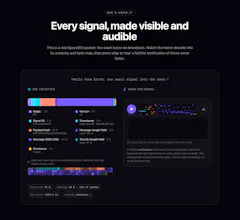
SpaceSIO is the Signal Issuance Operator for messages sent beyond Earth. Turn a message, image, or dedication into a real transmitted radio signal, with a verifiable proof-of-issuance record.



Free
Launch Team

Customer.ioAutomate Messaging Everywhere — Startups Get 12 Months Free
Promoted
how deep space do the signals actually reach, and is the proof-of-issuance stored on-chain or in some other verifiable format?
@dilci75504 Good questions! On reach, there's no single number because it depends on a bunch of factors. The biggest one is honestly on the receiving end... how sensitive the equipment looking for signals actually is. A stronger, more sensitive receiver can pick up a signal from much farther out. To help with that, every signal gets broadcast once and then rebroadcast over time (we call them echoes) to maximize its chances of reaching something.
The bigger vision: we want anyone to be able to run a relay station. Think SETI@home, but in reverse. Instead of everyone listening for signals, people help send and relay them.
On the proof side, it's not on-chain. Each broadcast is signed by the transmitting station with an Ed25519 key, and that signed receipt (timestamp, frequency, approximate station location) is what backs your Certificate of Issuance. Anyone can verify the signature independently, so you get provable issuance without needing a blockchain.
Appreciate you digging in!
How does the proof-of-issuance record actually work on the technical side, like is it stored on-chain or through some other verifiable system I could check independently?
@erva914472 It's not on-chain, it's a signed receipt. When a relay station broadcasts your signal it signs a receipt with its Ed25519 key covering the payload hash, timestamp, frequency, and approximate station location. That signed receipt is what backs your Certificate of Issuance.
If you hit "Copy proof" on any confirmed signal and you'll get the station's public key, the signature, and the exact signed message. Drop those into any standard Ed25519 library and you can re-verify the whole thing yourself.