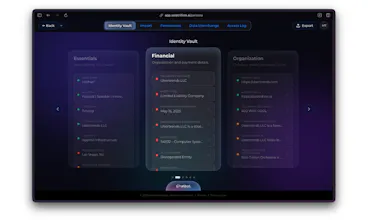
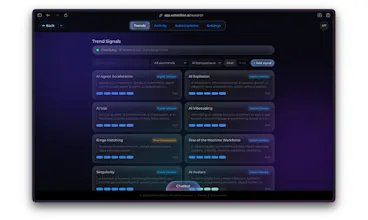
Solo Trillion is an AI-native operating layer for thought leaders and solo operators. Rosie works from a shared source of truth, monitors your newsletters, classifies trend signals, and turns conversations in the app chat drawer into tasks. The same system routes context into writing and research workflows, then delivers organized outputs through the app and Telegram. One shared source of truth. One conductor. One task surface.

Hey Product Hunt 👋
I’m Michael Tchong — long-time tech trend forecaster, keynote speaker, and the person behind Solo Trillion Orchestra.
Here’s the honest origin story: I built this because I was drowning. I had 30 years of trend intelligence, a newsletter, a speaking business, and nine websites — and I was spending more time managing tools than publishing ideas.
Every AI content tool I tried handed me a blank page, not much of a solution. Worse, they frequently sinned against basic rules of customer experience (see our ideas below).
So I built a four-agent platform designed to be modularly expandable, starting where every other tool stops — with your intelligence pipeline.
How it works:
Rosie, your AI chief of staff, monitors your newsletter subscriptions daily, classifies every story across 50 trend categories, and delivers a curated digest to Telegram. You approve what matters. The Writing Agent generates articles, Field Guides, and LinkedIn posts in your voice — trained on your brand, your guidelines, your edge.
What makes it different:
Most AI tools are generic content machines. Solo Trillion Orchestra is built around your proprietary framework. The output sounds like you because it’s trained on you.
One more thing:
We’re also launching AIX — the AI Interchange Standard. Open source, Apache 2.0. Because the AI industry has a markdown problem nobody is talking about. Every major chatbot renders markdown differently. We’re fixing that. Stay tuned for the video.
Solo Trillion Orchestra is live today at app.solotrillion.ai. Join the beta — first 100 users get white-glove onboarding.
Questions? I’m here all day. Let’s talk trends, AI agents, or why the AI industry’s markdown problem is costing developers thousands of hours annually.
— Michael
Report
The "classifies trend signals daily" part — what's Rosie actually pulling from? Just newsletters you manually feed in, or does she connect to RSS feeds, Twitter lists, Substack subscriptions? The sourcing quality seems like it determines whether the whole pipeline is useful or just noise dressed up as curation.
Report
Maker
@sounak_bhattacharya Thanks, that’s a good question and a fair challenge. You’re right that sourcing quality is the whole game — a classifier is only as good as what flows into it.
Rosie currently pulls from Gmail newsletter ingestion as the primary source. I subscribe to ~40 curated newsletters across tech, culture, consumer behavior, finance, and media — the signal layer I’ve been refining for years as a trend forecaster. These hit a dedicated inbox, Rosie ingests them on a daily schedule, parses individual articles out of each newsletter, and classifies every item against my nine Ubertrends framework plus a Layer 0 filter of 49 coined subtrends (Screensucking, Slopulism, Greedflation, etc.).
The reason I started with newsletters rather than RSS or Twitter lists is that newsletters are already a human-curated layer. A good editor has pre-filtered a firehose down to what matters. RSS gives you everything a publication posts; a newsletter gives you what that publication’s editor thought was worth your attention this week. Stacking 40 of those gets you a meta-curation layer before any AI touches it.
That said, the roadmap does expand sourcing — X/Twitter trend monitoring via an MCP integration is in progress, and screenshot ingestion via Telegram is already live for when I spot something in the wild that isn’t in a newsletter yet. RSS is deliberately lower priority because it reintroduces the noise problem the newsletter layer was solving.
The classification itself uses semantic rather than keyword matching, which affects the branded subtrend layer, since terms like “Slopulism” won’t appear literally in headlines — Rosie has to recognize the pattern.
So the honest answer: it’s not noise dressed up as curation because the curation happens three times: by the newsletter editors I’ve chosen, by my choice of which newsletters to subscribe to, and by the classification layer on top. Whether that produces genuinely useful trend intelligence vs. just well-organized noise is the question STO is built to answer publicly.
Report
Maker
@sounak_bhattacharya Thanks, that’s a good question and a fair challenge. You’re right that sourcing quality is the whole game — a classifier is only as good as what flows into it.
Rosie currently pulls from Gmail newsletter ingestion as the primary source. I subscribe to ~40 curated newsletters across tech, culture, consumer behavior, finance, and media — the signal layer I’ve been refining for years as a trend forecaster. These hit a dedicated inbox, Rosie ingests them on a daily schedule, parses individual articles out of each newsletter, and classifies every item against my nine Ubertrends framework plus a Layer 0 filter of 49 coined subtrends (Screensucking, Slopulism, Greedflation, etc.).
The reason I started with newsletters rather than RSS or Twitter lists is that newsletters are already a human-curated layer. A good editor has pre-filtered a firehose down to what matters. RSS gives you everything a publication posts; a newsletter gives you what that publication’s editor thought was worth your attention this week. Stacking 40 of those gets you a meta-curation layer before any AI touches it.
That said, the roadmap does expand sourcing — X/Twitter trend monitoring via an MCP integration is in progress, and screenshot ingestion via Telegram is already live for when I spot something in the wild that isn’t in a newsletter yet. RSS is deliberately lower priority because it reintroduces the noise problem the newsletter layer was solving.
The classification itself uses semantic rather than keyword matching, which affects the branded subtrend layer, since terms like “Slopulism” won’t appear literally in headlines — Rosie has to recognize the pattern.
So the honest answer: it’s not noise dressed up as curation because the curation happens three times: by the newsletter editors I’ve chosen, by my choice of which newsletters to subscribe to, and by the classification layer on top. Whether that produces genuinely useful trend intelligence vs. just well-organized noise is the question STO is built to answer publicly.
Report
This is exactly the model I've been running as a solo finance content creator. One person operating like a media company — content, distribution, community — powered by AI workflows. I run the Mod3Loop YouTube channel (https://www.youtube.com/@Mod3Loop) covering financial modeling for M&A and renewable energy, and the AI-assisted production stack has been a game changer for staying consistent without a team. The framing of "four AI agents" maps perfectly to what I'm doing across research, scripting, editing workflow, and community management. Congrats on the launch — this fills a real gap.
Report
Maker
@samir_asadov Thanks, Samir, I appreciate you stopping by — the solo-operator-as-media-company pattern is exactly the thesis Solo Trillion Orchestra is built around, so it's good to see it playing out in finance content too. The "consistency without a team" piece is the real unlock; that's what collapses when you're doing it manually and what AI workflows actually solve.
Solo Trillion Orchestra is very much in active build — more agents, deeper integrations, and sharper orchestration coming over the next weeks. The four-agent architecture is the foundation, not the ceiling. Good luck with Mod3Loop.
Report
No reviews yetBe the first to leave a review for Solo Trillion
The "classifies trend signals daily" part — what's Rosie actually pulling from? Just newsletters you manually feed in, or does she connect to RSS feeds, Twitter lists, Substack subscriptions? The sourcing quality seems like it determines whether the whole pipeline is useful or just noise dressed up as curation.
@sounak_bhattacharya Thanks, that’s a good question and a fair challenge. You’re right that sourcing quality is the whole game — a classifier is only as good as what flows into it.
Rosie currently pulls from Gmail newsletter ingestion as the primary source. I subscribe to ~40 curated newsletters across tech, culture, consumer behavior, finance, and media — the signal layer I’ve been refining for years as a trend forecaster. These hit a dedicated inbox, Rosie ingests them on a daily schedule, parses individual articles out of each newsletter, and classifies every item against my nine Ubertrends framework plus a Layer 0 filter of 49 coined subtrends (Screensucking, Slopulism, Greedflation, etc.).
The reason I started with newsletters rather than RSS or Twitter lists is that newsletters are already a human-curated layer. A good editor has pre-filtered a firehose down to what matters. RSS gives you everything a publication posts; a newsletter gives you what that publication’s editor thought was worth your attention this week. Stacking 40 of those gets you a meta-curation layer before any AI touches it.
That said, the roadmap does expand sourcing — X/Twitter trend monitoring via an MCP integration is in progress, and screenshot ingestion via Telegram is already live for when I spot something in the wild that isn’t in a newsletter yet. RSS is deliberately lower priority because it reintroduces the noise problem the newsletter layer was solving.
The classification itself uses semantic rather than keyword matching, which affects the branded subtrend layer, since terms like “Slopulism” won’t appear literally in headlines — Rosie has to recognize the pattern.
So the honest answer: it’s not noise dressed up as curation because the curation happens three times: by the newsletter editors I’ve chosen, by my choice of which newsletters to subscribe to, and by the classification layer on top. Whether that produces genuinely useful trend intelligence vs. just well-organized noise is the question STO is built to answer publicly.
@sounak_bhattacharya Thanks, that’s a good question and a fair challenge. You’re right that sourcing quality is the whole game — a classifier is only as good as what flows into it.
Rosie currently pulls from Gmail newsletter ingestion as the primary source. I subscribe to ~40 curated newsletters across tech, culture, consumer behavior, finance, and media — the signal layer I’ve been refining for years as a trend forecaster. These hit a dedicated inbox, Rosie ingests them on a daily schedule, parses individual articles out of each newsletter, and classifies every item against my nine Ubertrends framework plus a Layer 0 filter of 49 coined subtrends (Screensucking, Slopulism, Greedflation, etc.).
The reason I started with newsletters rather than RSS or Twitter lists is that newsletters are already a human-curated layer. A good editor has pre-filtered a firehose down to what matters. RSS gives you everything a publication posts; a newsletter gives you what that publication’s editor thought was worth your attention this week. Stacking 40 of those gets you a meta-curation layer before any AI touches it.
That said, the roadmap does expand sourcing — X/Twitter trend monitoring via an MCP integration is in progress, and screenshot ingestion via Telegram is already live for when I spot something in the wild that isn’t in a newsletter yet. RSS is deliberately lower priority because it reintroduces the noise problem the newsletter layer was solving.
The classification itself uses semantic rather than keyword matching, which affects the branded subtrend layer, since terms like “Slopulism” won’t appear literally in headlines — Rosie has to recognize the pattern.
So the honest answer: it’s not noise dressed up as curation because the curation happens three times: by the newsletter editors I’ve chosen, by my choice of which newsletters to subscribe to, and by the classification layer on top. Whether that produces genuinely useful trend intelligence vs. just well-organized noise is the question STO is built to answer publicly.
This is exactly the model I've been running as a solo finance content creator. One person operating like a media company — content, distribution, community — powered by AI workflows. I run the Mod3Loop YouTube channel (https://www.youtube.com/@Mod3Loop) covering financial modeling for M&A and renewable energy, and the AI-assisted production stack has been a game changer for staying consistent without a team. The framing of "four AI agents" maps perfectly to what I'm doing across research, scripting, editing workflow, and community management. Congrats on the launch — this fills a real gap.
@samir_asadov Thanks, Samir, I appreciate you stopping by — the solo-operator-as-media-company pattern is exactly the thesis Solo Trillion Orchestra is built around, so it's good to see it playing out in finance content too. The "consistency without a team" piece is the real unlock; that's what collapses when you're doing it manually and what AI workflows actually solve.
Solo Trillion Orchestra is very much in active build — more agents, deeper integrations, and sharper orchestration coming over the next weeks. The four-agent architecture is the foundation, not the ceiling. Good luck with Mod3Loop.