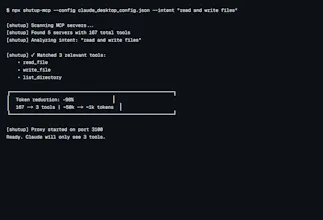
I built this after watching my Claude Code setup burn ~60,000 tokens just loading tool definitions from four MCP servers—before I even typed a prompt.
The problem: MCP gives agents access to hundreds of tools, but every tool description eats context. Redis published data showing the same thing—167 tools, 42% selection accuracy, 60K tokens of overhead per session. In production, it can hit 150K+ tokens. The agent spends more time deciding what to use than actually solving your problem.
Existing solutions fell into two buckets:
- Manual whitelists (mcpwrapped, MCP Funnel): You have to know in advance which tools to hide. With 100+ tools across multiple servers, that's a part-time job.
- Commercial platforms (Stacklok, Redis): Excellent accuracy (Stacklok hits 94%), but closed-source or require Redis infrastructure.
I wanted something that:
1. Works out of the box with my existing claude_desktop_config.json
2. Figures out which tools I need based on what I'm actually trying to do
3. Runs 100% locally, no API keys, no telemetry
4. Is open-source and dead simple to contribute to
So I built `shutup-mcp` in about 200 lines of Python. It aggregates tools from all your MCP servers, builds a local embedding index (all-MiniLM-L6-v2, ~80MB), and filters tools by intent before the agent sees them. Token reduction in my testing is ~98%—similar to what Redis and Atlassian reported with comparable approaches.
It's v0.1.0, so there's plenty left to build (dynamic re-filtering per message is next). I'd love feedback from anyone else hitting MCP tool sprawl—what's your current workaround? Regex filters? Specialized agents? Just eating the token cost?
Thanks for checking it out. Happy to answer any questions in the comments.
Report
98% token reduction is wild. I've been working with MCP servers and the tool list bloat is a real problem the agent spends half its context just reading tool descriptions. The zero-config approach is smart because the moment you ask devs to configure which tools to expose, you've already lost. How does it decide which tools to surface for a given query?
BM25 keyword matching (exact term matching — catches "GitHub" vs "git")
RRF fusion to merge both result sets without score normalization
Industry benchmarks show this pushes tool selection accuracy from ~38% (vector alone) to ~94% (hybrid). Token reduction stays ~98%.
Honest caveat: intent extraction currently happens during tool calls. Pure conversation first steps (no tool invocation yet) still see the full tool set. Closing that gap in a future version.
Curious—in your MCP setups, do you find the agent picking the wrong tool more often, or just burning tokens on descriptions? The failure mode tells you which part of the pipeline needs tuning.
Report
"Not a dashboard, a co-worker" this positioning resonates. As a solo founder, I don't have a data team to investigate why a metric dropped. I just see the drop and panic. The idea of an AI that can connect the dots between a code release and a metric change is exactly what small teams need. How granular does the root cause analysis get?
shutup-mcp
98% token reduction is wild. I've been working with MCP servers and the tool list bloat is a real problem the agent spends half its context just reading tool descriptions. The zero-config approach is smart because the moment you ask devs to configure which tools to expose, you've already lost. How does it decide which tools to surface for a given query?
shutup-mcp
@linoy_bar_gal — thanks for the kind words, and great question.
The proxy extracts intent from each user message, then uses hybrid search to find the most relevant tools. Hybrid means:
Vector embeddings (semantic similarity — understands "read a file" ≈ "open document")
BM25 keyword matching (exact term matching — catches "GitHub" vs "git")
RRF fusion to merge both result sets without score normalization
Industry benchmarks show this pushes tool selection accuracy from ~38% (vector alone) to ~94% (hybrid). Token reduction stays ~98%.
Honest caveat: intent extraction currently happens during tool calls. Pure conversation first steps (no tool invocation yet) still see the full tool set. Closing that gap in a future version.
Curious—in your MCP setups, do you find the agent picking the wrong tool more often, or just burning tokens on descriptions? The failure mode tells you which part of the pipeline needs tuning.
"Not a dashboard, a co-worker" this positioning resonates. As a solo founder, I don't have a data team to investigate why a metric dropped. I just see the drop and panic. The idea of an AI that can connect the dots between a code release and a metric change is exactly what small teams need. How granular does the root cause analysis get?