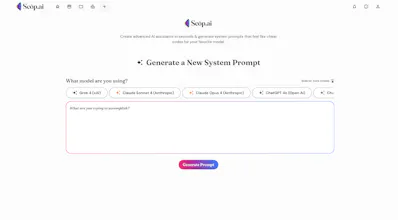
Generate task & model specific AI system prompts for leading LLMs, browse over 200 tested prompt templates, and collaborate on prompts with team members through shared prompt collections.
No reviews yetBe the first to leave a review for Scop.ai
Maker
📌
Excited to announce the launch of Scōp.ai
After losing countless system prompts in docs between different accounts, and pages buried in Notion, I was tired of watching hours of prompt optimization work go to waste...
But the real problem wasn't just organization - it was model-specific optimization (that didn't take an hour of manual prompting per task) and consistently delivered better results across models.
For example, what works for GPT can completely fall flat with Claude, or that perfect prompt you have on a reasoning model... it might throw you through a loop. Each model needs its own approach, but most of the time the same generic prompts are used everywhere.
After trying some initial solutions, one wasn't mobile compatible, the other was way too bulky for my daily workflow. Neither had the prompt quality or depth, paired with the ease of use I was searching for, so Scōp.ai was born.
Scōp enables users to:
✓ Generate & Store: AI-powered system prompt generation optimized for each model + all your best prompts in one place
✓ Share & Collaborate: Create shared prompt libraries your whole team can access and improve
✓ Browse & Clone 200+ Templates: Skip the learning curve with prompts for every use case & leading LLM
✓ Cross-Platform: Access or generate prompts in seconds from anywhere (desktop & mobile web app)
Whether you're using GPT, Claude, Gemini, Grok, etc...
1. Select your model
2. Give Scōp.ai context on your task or goal
3. Paste in the output before you start chatting with the LLM to turn prompt chaos into model-ready instructions
Try for free → https://scop.ai/
Report
Maker
Grok 4 system prompt generation & templates are live on Scop.ai!
Generate custom task & model specific prompts, or browse a number of templates - each one engineered specifically for Grok 4's unique architecture, including:
Real-Time Market Intelligence Scanner
Research Paper Synthesizer Pro
Competitive Intelligence Command Center
Technology Stack Investigator
Patent Landscape Mapper
Executive Decision Support System
Strategic SWOT Analyzer
OKR Alignment Optimizer
Pitch Deck Perfection Engine
M&A Due Diligence Assistant
API Documentation Genius
Intelligent Code Review Bot
Bug Pattern Analyzer
Architecture Decision Advisor
Security Vulnerability Hunter
LinkedIn Virality Engineer
Newsletter Engagement Maximizer
Brand Voice Consistency Guardian
Story Arc Engineer
SEO Content Optimizer
Prompt Engineering Sensei
Model Performance Diagnostician
Workflow Automation Architect
AI Integration Specialist
Multi-Agent System Designer
+ more!
Each template leverages what makes Grok 4 special:
How does the system handle model updates like from GPT-4 to GPT-4.5 that might change how a prompt behaves? Are there tools available to flag or revalidate prompts after an update?
One of the things that makes prompt management tricky for sure!
Right now our prompts are optimized per model based on the initial task requirements. If you want to convert a prompt to a different model, just select the new model when generating and give Scop.ai your current prompt - it will refactor based on the strengths of the new model, which handles most compatibility issues. :)
We're building versioning, then prompt evaluations elements of performance tracking & update recommendations in Q3 for even more precision & control. Appreciate the thoughtful question & looking forward to sharing more updates on this!
Report
I love the concept. Can prompts have dynamic variables or placeholders that get filled in during runtime?
Report
Maker
@sadie_scott Thank you Sadie! Currently you can instruct Scop.ai to add variable placeholders during initial generation, or manually add them afterward.
Enhanced custom variable features and fine-tuning controls plus versioning for even more dynamic control are coming soon as well 🛠️
Report
Amazing concept. How do you manage the differences in LLM behavior across providers like OpenAI, Claude or Mistral?
Our generation process creates custom prompts tailored to each model's specific strengths and benchmarks - so a Claude prompt leverages its reasoning abilities differently than a GPT prompt optimizes for creativity, for example!
We also use one-shot and multi-shot testing on proven prompts for generations to ensure they work consistently across providers, and often update our own generation instructions based on real testing results!
Curious which models are you working with most?
Report
This is really impressive work. Does this allow for prompt testing across multiple models side by side?
Grok 4 system prompt generation & templates are live on Scop.ai!
Generate custom task & model specific prompts, or browse a number of templates - each one engineered specifically for Grok 4's unique architecture, including:
Real-Time Market Intelligence Scanner
Research Paper Synthesizer Pro
Competitive Intelligence Command Center
Technology Stack Investigator
Patent Landscape Mapper
Executive Decision Support System
Strategic SWOT Analyzer
OKR Alignment Optimizer
Pitch Deck Perfection Engine
M&A Due Diligence Assistant
API Documentation Genius
Intelligent Code Review Bot
Bug Pattern Analyzer
Architecture Decision Advisor
Security Vulnerability Hunter
LinkedIn Virality Engineer
Newsletter Engagement Maximizer
Brand Voice Consistency Guardian
Story Arc Engineer
SEO Content Optimizer
Prompt Engineering Sensei
Model Performance Diagnostician
Workflow Automation Architect
AI Integration Specialist
Multi-Agent System Designer
+ more!
Each template leverages what makes Grok 4 special:
✅ Deep thinking
✅ Real-time data synthesis from web + X
✅ Code interpreter for verification
Sign up here → https://scop.ai/
How does the system handle model updates like from GPT-4 to GPT-4.5 that might change how a prompt behaves? Are there tools available to flag or revalidate prompts after an update?
@jacob_hernandez4
Hey Jacob,
One of the things that makes prompt management tricky for sure!
Right now our prompts are optimized per model based on the initial task requirements. If you want to convert a prompt to a different model, just select the new model when generating and give Scop.ai your current prompt - it will refactor based on the strengths of the new model, which handles most compatibility issues. :)
We're building versioning, then prompt evaluations elements of performance tracking & update recommendations in Q3 for even more precision & control. Appreciate the thoughtful question & looking forward to sharing more updates on this!
I love the concept. Can prompts have dynamic variables or placeholders that get filled in during runtime?
@sadie_scott Thank you Sadie! Currently you can instruct Scop.ai to add variable placeholders during initial generation, or manually add them afterward.
Enhanced custom variable features and fine-tuning controls plus versioning for even more dynamic control are coming soon as well 🛠️
Amazing concept. How do you manage the differences in LLM behavior across providers like OpenAI, Claude or Mistral?
@logan_king
Hi Logan!
Our generation process creates custom prompts tailored to each model's specific strengths and benchmarks - so a Claude prompt leverages its reasoning abilities differently than a GPT prompt optimizes for creativity, for example!
We also use one-shot and multi-shot testing on proven prompts for generations to ensure they work consistently across providers, and often update our own generation instructions based on real testing results!
Curious which models are you working with most?
This is really impressive work. Does this allow for prompt testing across multiple models side by side?
@juan_smith1 Hey Juan, Really appreciate that!
We don't have side-by-side testing yet, but honestly that's such a smart feature idea and would be incredibly valuable for optimization.
Thanks for the suggestion & looking forward to sharing more on this soon!
Smoopit
Smart timing with the prompt engineering space evolving so quickly. How do you keep the 200+ templates updated as models change? @dylan_scop_ai