Launching today

RuVector
Open source AI search that adapts from experience
5 followers
Open source AI search that adapts from experience
5 followers
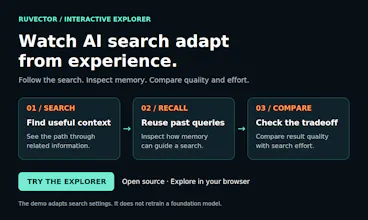
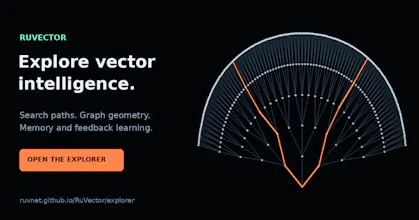
Watch AI search adapt from experience. RuVector is an open source toolkit for finding relevant information and reusing useful context. Try the Explorer to see search paths, query memory and adaptive search settings. Compare result quality with search effort, then explore applications such as support assistants and recommendations. The browser demo adjusts search settings; it does not retrain a foundation model.






Nick here from Cognitum One 👋
Every AI workflow faces a practical question:
What needs a language model, what can be decided locally, and how does the system learn from the result❓
That’s why I’m excited to bring RuVector to Product Hunt. 🚀
Built by @ruv Cohen, RuVector brings vector search, graph relationships, persistent agent memory and feedback learning into a Rust foundation for AI applications.
The bigger picture spans three complementary layers:
⚡ System 0: Sense & Respond
Make bounded local decisions, such as routing a request or classifying intent, without a full LLM call for every step.
🧠 System 1: Learn & Remember
Retain context across sessions, retrieve relevant evidence and adapt from recorded outcomes and feedback.
🔗 System 2: Reason & Orchestrate
Connect that foundation with RuvLLM, RVF, Ruflo and MetaHarness for more complex reasoning and coordinated workflows.
What excites me is the engineering possibility: a support system that routes routine requests locally, retrieves the relationships behind a difficult case, and records whether the resolution worked.
Memory, decisions and learning connected in one architecture, with developers choosing the components and controls their application needs.
We’d love your feedback. Where would this make the biggest difference in what you’re building?
🔧 Explore the code: https://github.com/ruvnet/ruvector
💻 Try the live demo: https://cognitum.one/ruvector
Hi all, this is Dragan from Cognitum One.
I’m part of the team launching RuVector, and I’ve used its components in my own open-source projects and in our work at Cognitum One. Calling it a vector database only tells part of the story. For me, it’s a box of building blocks I can combine to solve a wide range of problems.
In Agentic QE, I’ve integrated SONA into the learning loop: matching QE patterns to new tasks, recording what worked, and retaining those patterns across sessions. The value is reusing experience rather than starting every task from scratch.
In Nagual-QE, my knowledge and learning system, I use a different combination: vector-storage integration and domain-expansion components for transferring learned priors between problem domains. Finding relevant knowledge and carrying useful experience into a new context are related, but they aren’t the same problem.
We also use RuVector components across several Cognitum projects. These are building blocks I work with, not just features I’ve read about. And my examples cover only a small part of what rUv has been building with this ecosystem.
If you’re wondering where to start, try the Explorer: https://ruvnet.github.io/RuVector/explorer/
It makes the different possibilities much easier to grasp. Start with a problem you actually have, explore the components, and build from there.
I’m glad to be helping bring this release to more people. Try it on a real project and let us know what you discover.