
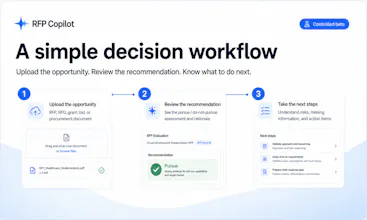
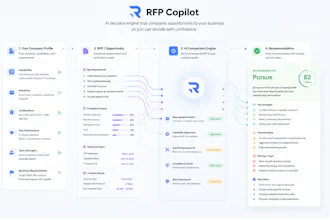
RFP Copilot is a decision engine for RFPs, RFQs, grants, bids, and procurement opportunities. It compares opportunities against a company’s profile, capabilities, and requirements to help teams decide whether an opportunity is worth pursuing, understand why, and know what to do next before investing serious proposal time. Most proposal tools start after the decision to bid. RFP Copilot starts upstream at the pursue / do-not-pursue decision.



Free Options
Launch Team / Built With


Hi Product Hunt 👋
I'm Jonathan Goodman, founder of Halyard Consulting and creator of RFP Copilot.
I built RFP Copilot after seeing how much time organizations spend pursuing opportunities that were never strong fits in the first place.
Whether it's an RFP, RFQ, grant, bid, or procurement opportunity, teams often spend hours—or even days—reviewing requirements, coordinating internally, and preparing responses before realizing the opportunity may not align with their capabilities, capacity, timeline, or strategic priorities.
Most tools focus on writing proposals.
RFP Copilot focuses on the decision that comes before proposal writing begins.
Upload an opportunity and compare it against your organization's profile, capabilities, and requirements to evaluate fit, risks, missing information, deadlines, and recommended next steps.
The goal is to help answer three simple questions:
• Should we pursue this?
• Why?
• What do we need to do next?
RFP Copilot is designed for consultants, nonprofits, proposal teams, GovCon professionals, and organizations that regularly evaluate revenue and funding opportunities.
Thank you for taking a look. I'd love to hear how your team currently handles bid/no-bid decisions, opportunity qualification, and early-stage pursuit planning.
Your feedback, questions, and ideas are welcome.
I've watched a lot of teams pour days into pursuits that were never a fit, and the expensive part was never the writing. It was the time spent chasing the wrong thing. RFP Copilot sits exactly where that decision gets made, before the proposal, which is the part most teams rush.
I ran a few sample RFPs through it this morning. What stood out is that it actually reasons and summarizes instead of just answering a simple yes or no. It leads with a recommendation, shows the scoring behind it, and pulls the evidence it's leaning on. That's real heavy lifting on a problem that is genuinely underserved. It's early and there's room to grow, but the core of RFP Copilot spot on and it's pointed directly at the part of the process that quietly burns the most time.
If you work with RFPs, grants, or bids and you've ever wished someone had pumped the brakes before a bad pursuit before burning too many hours, this is tottaly worth a look. Congrats to Jonathan and the Halyard team!
@nigel_hickey Thank you, this means a lot. You captured exactly what we’re trying to solve. The expensive mistake often happens before proposal writing starts, when a team commits time to an opportunity that was never really aligned in the first place.
That’s why we built RFP Copilot as a decision-first system: recommendations, reasoning, risks, missing information, and evidence before the team invests days into the response.
Really appreciate you testing it, sharing thoughtful feedback, and supporting the launch.
RFPs are one of those tasks that everyone knows are important but nobody enjoys doing 😅 What's the biggest time sink customers usually eliminate first when they start using RFP Copilot?
Such an easy tool to use - if you are dealing with so many solicitations and RFIs then this is something that you will always need. There is good enough functions to make it simple in about a minute to understand wither to chase an opportunity or not. I can further explain this but you want to experience it your way!
@samim2020 Thank you. I really appreciate this. You’re exactly right: when a team is dealing with multiple solicitations, RFIs, bids, or procurement opportunities, the first challenge is often deciding which ones are actually worth chasing.
That’s the decision we’re trying to make faster, clearer, and more structured before people invest serious time in the response.
I appreciate you taking a look and sharing this feedback.