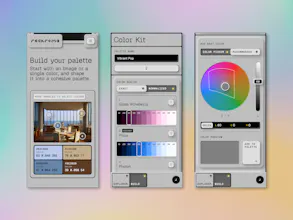
Rechroma is a workspace for exploring color, shaping palettes, and building complete color systems for products, brands, interfaces, and more. Start with a color or image, explore recommendations in Oklch, preview your palette, and export to Figma or code.
GPT-5.6 amplified how complete I could make Rechroma before launch. I had already used GPT-5.5 to establish the foundation, but 5.6 was noticeably better at keeping the broader product in context, reasoning through complex interactions, and carrying work from implementation through testing and polish. That gave me the productivity boost necessary to ship a product beyond a preview or beta: a cohesive color workspace with perceptual recommendations, scales, contrast tools, visual previews, saved systems, and practical exports. It also helped with less visible launch work like edge cases, onboarding, reliability, documentation, and presentation.
Hey Product Hunt! I’m John, creator of Rechroma and I'm excited to share it with the world.
Rechroma started as a tool I wanted for web projects: a faster way to assemble a color palette, generate its tints and shades, and turn everything into usable design tokens. Picking colors is an art and a science, and rebuilding every scale as Figma variables and CSS tokens is incredibly tedious.
While building it, I asked why certain palettes feel appealing or carry a certain energy/vibe. That led me to build Rechroma around Oklab and Oklch, perceptual color spaces that make relationships between colors easier to see and measure. I also analyzed a large collection of palettes to capture different visual styles. Those patterns now inform Rechroma’s palette recommendations.
With Rechroma, you can:
- Extract a palette from any image or start with a single color
- Get harmonious recommendations based on the colors you already have
- Generate complete color scales and check contrast
- Preview the palette in context with the Visualizer
- Sync the full system to Figma variables in one click with the Figma plugin
- Export design tokens to CSS and SCSS
The core creation tools are free. Rechroma Pro adds saved workspaces, Explorer, Figma sync, and exports. There’s a seven-day free trial available for Pro, and I'm offering early-bird through the end of this year.
If you work with color - whether in products, brands, interfaces, design systems, or code - I’d love for you to try Rechroma and tell me what you think.
A big thank you to the early testers whose feedback helped get Rechroma ready to launch, and thanks to everyone here for taking a look.
the Oklch foundation makes sense to me, that's the right color space for this instead of just doing math in RGB or HSL and hoping it looks right. curious about the recommendation engine though - you mentioned analyzing a large collection of palettes to capture visual styles, does that risk pulling suggestions toward whatever styles were most common in that collection, so a brand wanting something genuinely unusual gets steered back toward safer/trendier combos? or does the perceptual math give you enough range that it's not really pattern-matching against the training set in that way?
@galdayan thanks for this question! Corpus bias is a real risk, but the collection isn't used to choose the statistically safest or most popular next color. Instead, I analyze and cluster palettes by their underlying color relationships - including hue, lightness, chroma, and overall shape - so recommendations can draw from distinct visual families rather than just reinforcing the most common style.
I've tried to include a broad variety of styles, and Rechroma also mixes in traditional harmonies like complementary, analogous, tetradic, etc. so users get a wide range of directions/choices.
And for brands that want something genuinely weird or hand-picked, they can skip recommendations all together if they'd like, or make manual adjustments to the recommended palettes. Rechroma has an intuitive Oklch color picker, and all the workflow tooling (Color Kits, Visualizer, exports, Figma plugin) works just as well with manually created palettes.
Thanks again for checking it out!
Report
Congrats on the launch John! Building this on top of Oklch makes so much sense for perceptual smoothness, and the Figma variable sync looks like a massive time-saver. Quick question on the scale generation: how does Rechroma handle dark mode or multi-theme generation? Does it help map the semantic relationships between light and dark scales automatically, or do we generate them as separate palettes right now?
@srdjan_pajic thank you so much! And great question - right now Rechroma generates the color scales and assigns basic semantic roles based on your palette (by default it assigns "Primary" to the first color, "Supporting" to the second, and "Accent" to the third), but it doesn't automatically create paired light/dark modes or map semantic relationships between them yet.
The scales for each color run from dark to light (either normalized to L=10 through L=99, or mapped to whatever the L of your input color was), so right now you'd probably just move one or two steps up/down the scale depending on if you're in light or dark mode.
Something I'd like to add soon to the Color Kit is more customization of how the scales are generated - i.e. number of steps, step spacing, if the scale attempts to preserve chroma, etc. And also tooling around better semantic token generation and organization. Please stay tuned I'm excited to share more soon.
Report
Oh wow, this immediately reminded me of Adobe Kuler back in 2015. It's evolved a lot since then, but it isn't quite what it used to be. Your product delivers exactly what I always felt was missing from Kuler: flexibility, customization, and the ability to break down a color palette from a photo. Also, huge respect for the website design — it looks fantastic
@alvodsgn Lesha thank you for the kind words! I certainly remember and was inspired by all the various color tools I've used over the years, including Adobe Kuler, and agree that there were some key pieces missing. Please let me know if there are any other features, formats, and workflows that would be useful for you!
Report
@eliojohn Thanks! One thing I'd love to see is a Figma integration. I think being closer to where designers already work would create a much more seamless experience and could become a strong differentiator.
Also, do you see support for CMYK and Pantone palettes on the roadmap? I know that's a much bigger challenge in terms of color management and calibration, but it feels like it would make the tool truly complete for professional branding and print workflows.
Rechroma Pro users can link their accounts and palettes, and the plugin will import all of the colors (including the full color scales) with one click as native Figma variables. It's saved me a bunch of time in my own work and I'm eager for others to give it a try!
There are licensing considerations around Pantone, so direct Pantone support isn’t currently on the roadmap. Rechroma currently targets sRGB, with Display P3 support on the immediate roadmap. I’ve also thought about CMYK and would like to support it, although it needs to be handled carefully since the result depends on the intended print profile rather than a single universal conversion. Thanks again for the questions!
Rechroma
Rechroma
Dial
the Oklch foundation makes sense to me, that's the right color space for this instead of just doing math in RGB or HSL and hoping it looks right. curious about the recommendation engine though - you mentioned analyzing a large collection of palettes to capture visual styles, does that risk pulling suggestions toward whatever styles were most common in that collection, so a brand wanting something genuinely unusual gets steered back toward safer/trendier combos? or does the perceptual math give you enough range that it's not really pattern-matching against the training set in that way?
Rechroma
@galdayan thanks for this question! Corpus bias is a real risk, but the collection isn't used to choose the statistically safest or most popular next color. Instead, I analyze and cluster palettes by their underlying color relationships - including hue, lightness, chroma, and overall shape - so recommendations can draw from distinct visual families rather than just reinforcing the most common style.
I've tried to include a broad variety of styles, and Rechroma also mixes in traditional harmonies like complementary, analogous, tetradic, etc. so users get a wide range of directions/choices.
And for brands that want something genuinely weird or hand-picked, they can skip recommendations all together if they'd like, or make manual adjustments to the recommended palettes. Rechroma has an intuitive Oklch color picker, and all the workflow tooling (Color Kits, Visualizer, exports, Figma plugin) works just as well with manually created palettes.
Thanks again for checking it out!
Congrats on the launch John! Building this on top of Oklch makes so much sense for perceptual smoothness, and the Figma variable sync looks like a massive time-saver.
Quick question on the scale generation: how does Rechroma handle dark mode or multi-theme generation? Does it help map the semantic relationships between light and dark scales automatically, or do we generate them as separate palettes right now?
Rechroma
@srdjan_pajic thank you so much! And great question - right now Rechroma generates the color scales and assigns basic semantic roles based on your palette (by default it assigns "Primary" to the first color, "Supporting" to the second, and "Accent" to the third), but it doesn't automatically create paired light/dark modes or map semantic relationships between them yet.
The scales for each color run from dark to light (either normalized to L=10 through L=99, or mapped to whatever the L of your input color was), so right now you'd probably just move one or two steps up/down the scale depending on if you're in light or dark mode.
Something I'd like to add soon to the Color Kit is more customization of how the scales are generated - i.e. number of steps, step spacing, if the scale attempts to preserve chroma, etc. And also tooling around better semantic token generation and organization. Please stay tuned I'm excited to share more soon.
Oh wow, this immediately reminded me of Adobe Kuler back in 2015. It's evolved a lot since then, but it isn't quite what it used to be. Your product delivers exactly what I always felt was missing from Kuler: flexibility, customization, and the ability to break down a color palette from a photo. Also, huge respect for the website design — it looks fantastic
Great job, and best of luck with the launch!
Rechroma
@alvodsgn Lesha thank you for the kind words! I certainly remember and was inspired by all the various color tools I've used over the years, including Adobe Kuler, and agree that there were some key pieces missing. Please let me know if there are any other features, formats, and workflows that would be useful for you!
@eliojohn Thanks! One thing I'd love to see is a Figma integration. I think being closer to where designers already work would create a much more seamless experience and could become a strong differentiator.
Also, do you see support for CMYK and Pantone palettes on the roadmap? I know that's a much bigger challenge in terms of color management and calibration, but it feels like it would make the tool truly complete for professional branding and print workflows.
Cheers!
Rechroma
@alvodsgn there actually is a Figma plugin available here: https://www.figma.com/community/plugin/1652049231660374811/rechroma
Rechroma Pro users can link their accounts and palettes, and the plugin will import all of the colors (including the full color scales) with one click as native Figma variables. It's saved me a bunch of time in my own work and I'm eager for others to give it a try!
There are licensing considerations around Pantone, so direct Pantone support isn’t currently on the roadmap. Rechroma currently targets sRGB, with Display P3 support on the immediate roadmap. I’ve also thought about CMYK and would like to support it, although it needs to be handled carefully since the result depends on the intended print profile rather than a single universal conversion. Thanks again for the questions!