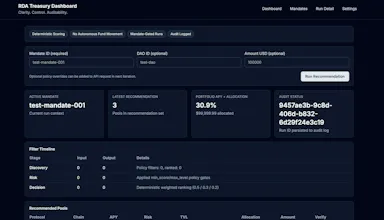
Most DAO treasuries hold idle stablecoins earning nothing. RDA scans 19,000+ DeFi pools, scores them against DAO-approved policies, and generates Snapshot-ready proposals in seconds—no fund movement. Unlike other tools, RDA is mandate-gated, non-custodial, and fully explainable, delivering risk-aware, governance-aligned recommendations with a complete audit trail. Open source, no custody, no execution. Just governance-aligned recommendations with a full audit trail.
No reviews yetBe the first to leave a review for RDA — Robo DeFi Advisor
Maker
📌
Hey Product Hunt! 👋
I built RDA after seeing how much idle capital DAO treasuries leave on the table — not because governance doesn't care, but because the research-to-proposal pipeline is painfully slow.
A few things I'd love your feedback on:
1. The mandate system — DAOs define investment rules (protocols, chains, risk limits, APY targets) in a JSON policy. Every recommendation is bounded by it. Does this feel like the right primitive for governance-aligned AI?
2. The risk model - scoring is fully deterministic: TVL weight + protocol tier + APY sustainability + exploit history. No LLM in the ranking loop. Intentional for auditability. Overkill?
3. The Kelp-Aave cascade last week - Kelp isn't in our protocol registry, so it would have been blocked before discovery. The gap we're building toward is post-deployment monitoring (Phase 2 circuit breaker). Would love to hear from anyone who's dealt with treasury exposure during a protocol exploit.
Live demo: https://rdaadvisor.com
GitHub: https://github.com/truptisatsang...
Built on Fetch.ai uAgents + DeFiLlama + MeTTa. Happy to answer anything about the architecture.
Looks interesting, does it only support EVM chains for now? and how is it governance aligned, are you scanning governance contracts or following a general structure or some EIP?
Report
Maker
@hrishi_jd Currently, RDA is focused on EVM-compatible chains since most DeFi liquidity and standardized integrations exist there. On governance alignment RDA doesn’t scan governance contracts directly. Instead, it operates on a policy-driven model, where each DAO defines its own mandate (risk tolerance, preferred protocols, asset constraints, etc.).
All recommendations are then generated strictly within that policy and output as Snapshot-ready proposals so it fits into existing governance workflows rather than bypassing them. No custody, no execution just structured, explainable suggestions.
ContextPool
Looks interesting, does it only support EVM chains for now? and how is it governance aligned, are you scanning governance contracts or following a general structure or some EIP?
@hrishi_jd Currently, RDA is focused on EVM-compatible chains since most DeFi liquidity and standardized integrations exist there.
On governance alignment RDA doesn’t scan governance contracts directly. Instead, it operates on a policy-driven model, where each DAO defines its own mandate (risk tolerance, preferred protocols, asset constraints, etc.).
All recommendations are then generated strictly within that policy and output as Snapshot-ready proposals so it fits into existing governance workflows rather than bypassing them. No custody, no execution just structured, explainable suggestions.