
QX Flow
Local-first ETL for sensitive data
2 followers
Local-first ETL for sensitive data
2 followers
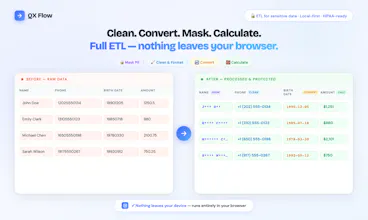
Open a file. QX Flow detects PII/PHI (phone, SSN, email) with 90%+ accuracy and recommends rules for clean, standardize, mask. For Excel, CSV, JSON ✅ Local-first – Runs in browser, zero uploads ✅ Smart recommendations – Suggests Protect, Clean, Standardize ✅ JSON-native – Mask nested fields via jsonPath ✅ Reusable workflows – Save & share rules ✅ Batch jobs – Automate tasks ✅ Formula builder – Drag-and-drop HIPAA, CCPA, GDPR ▶️ Demo: https://youtu.be/_TUow6zosjU 🔗 Try: qingxiflow.com



Hey Product Hunt 👋
I built QX Flow because I was tired of watching teams struggle with sensitive data in spreadsheets and manual scripts. The problem wasn't just "how do I mask this phone number?" — it was "how do I turn this messy file into something clean and safe without spending hours on formulas?"
I looked into using AI to automate the process, but most tools require sending your data to the cloud. That's a hard no when you're dealing with PII, PHI, or HIPAA-regulated data.
So I built something truly local-first. Here's what makes QX Flow different:
1. File-based ETL for sensitive data.
Open any Excel, CSV, or JSON file directly in your browser. Everything runs locally. No data ever leaves your device.
2. Smart recommendations — not "AI magic".
QX Flow uses pattern-based matching to automatically detect PII/PHI fields (phone, email, SSN, address) and suggests the right rules for masking, cleaning, or standardizing — all with a 90%+ match score. No setup, no manual tagging.
3. JSON-native, not just flattened.
Need to handle nested JSON? Most tools force it into a spreadsheet, breaking the structure. QX Flow keeps it intact. Target nested fields via jsonPath (e.g., $.users[*].phone), mask or clean them in place, and even write aggregated results back into the original structure. No flattening. No code.
4. No formulas to memorize. Just drag and drop.
Build custom logic by combining functions and fields like building blocks. Need more flexibility? Python UDFs are also supported.
5. Build once, reuse forever.
Save your workflows as reusable rule sets. Share them with your team. Schedule batch jobs. You're not just solving today's problem — you're building a library for the future.
6. It's not just about masking.
It's about the full pipeline: raw data → clean → standardize → calculate → aggregate → mask → export. All in one local-first workbench.
I built this for finance, audit, and compliance teams who want a better way to handle sensitive data without breaking the bank or breaking compliance rules.
Would love to hear what you think. Give it a try here: https://qingxiflow.com 🚀