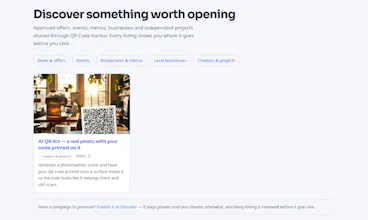
Static QR codes are free, unlimited, watermark-free and need no account. Dynamic ones stay editable after you've printed them, so a menu or flyer can be repointed without a reprint, and every scan is tracked by time, device and rough location. 37 content types, PNG/SVG export, and a documented HTTP API. There's also an AI mode that generates a real photograph and prints your code onto a surface in it — the code is a genuine QR, so it still scans.
Hi Product Hunt 👋
I built this after watching a restaurant near me reprint their whole menu because the link behind the QR code changed. That's the actual problem with printed QR codes: the paper is permanent and the destination isn't.
So the core of QR Code Harbor is dynamic codes — the code you print stays the same, and you can repoint it whenever you like, with scans tracked by time, device and rough location. Static codes are free and unlimited, no account, no watermark, and they don't expire.
The part I had the most trouble with is the AI mode. Most AI QR tools bend the entire picture into the shape of the code, which is why the results look like coloured mosaics rather than photographs. I went the other way: generate an ordinary photo, then composite a genuine QR matrix onto a surface in the scene — with a slight tilt, a contact shadow, and the scene's own lighting on the paper. Because the code is a real QR rather than a generated approximation, it actually scans.
Two things I'd genuinely like feedback on:
1. Does the photo mode look real to you, or does it still read as "pasted on"?
2. If you print QR codes for anything, what breaks most often?
Free tier is properly usable rather than a demo. Happy to answer anything.