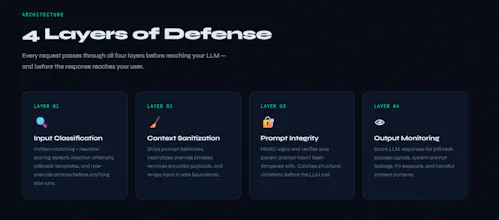
PromptShield sits between your users and your LLM, blocking prompt injection attacks before they reach the model. 4 layers of defense: 1. Input Classifier – detects malicious patterns 2. Context Sanitizer – strips injected instructions 3. Prompt Integrity Checker – validates structure 4. Output Monitor – catches successful injections Tunable aggression, API auth, rate limiting, audit logs, Python SDK, Docker. Benchmark tested. Built by a CS student from Nairobi, Kenya.
No reviews yetBe the first to leave a review for PromptShield LLMPrompt Injection Defense
Maker
📌
Hey Product Hunt! 👋
I'm Justin, a CS student from Nairobi, Kenya.
I built PromptShield because I noticed something scary —
companies are deploying LLMs in production with zero
protection against prompt injection attacks.
Attackers can hijack your AI, leak data, and bypass
your safeguards with a single malicious input.
So I built a middleware that intercepts every user input
before it touches the model and runs it through 4 defense
layers to catch and block attacks in real time.
The hardest part was getting zero false positives while
still catching 100% of attacks in benchmarks —
that balance took a lot of iteration.
Would love feedback from the community — especially
around edge cases and evasion techniques.
What would you try to break first? 🛡️
Report
The four-layer setup sounds solid, especially the output monitor since most tools skip that. One thing that would make this way more useful for teams: a rule sharing format or community-maintained blocklist for common injection payloads. Right now every company rediscovers the same patterns. A GitHub repo where users PR new attack signatures and you ship them as versioned feeds would save everyone time and make the classifier sharper with real-world data instead of just synthetic benchmarks.