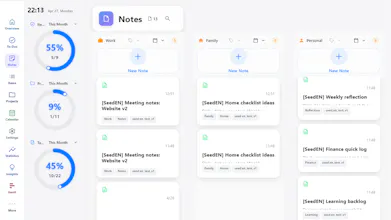
Most task managers help you organize tasks, but they ignore something: you're three different people — at work, at home, and alone with yourself. PrioTrix is built around a 3×3 matrix: three rows (Work, Family, Self) and three columns (Notes, Items, Projects). It respects that ideas start fuzzy, become clear items, and grow into projects — with a built-in flow that moves tasks from notes to actions to projects across work, family, and personal life.
No reviews yetBe the first to leave a review for Priotrix
Maker
📌
The idea for PrioTrix didn't come from a sudden insight. It came from a pattern I kept noticing in my own life.
I had work tasks in one tool, family stuff in a shared calendar, personal things in a notes app. Three different parts of my life, three different systems. And none of them talked to each other.
I also noticed that most tools ask you to decide everything upfront — project, priority, deadline — before you even know what you're dealing with. But real tasks don't start clear. They start as a thought, a note, something you don't want to forget. They only become clear over time.
I spent more time maintaining my system than actually getting things done. I had a long list, but I still didn't know what to focus on each day — especially when multiple things were piling up.
I had been looking for a tool that could unify work, family, and personal life — with an internal coordination mechanism that actually made sense. One that respects the space between “I need to remember this” and “I'm ready to act on it.” And one that could recommend what to focus on today, based on the roles, priorities, and dates I set. I never found one that felt right, so I decided to build it myself.
PrioTrix is designed around that idea — letting tasks flow naturally from notes to actions to projects, while keeping work, family, and personal life separate yet coordinated by the same framework. It also recommends what to focus on today, based on a combination of priorities, due dates, and your current role — so you don't have to stare at a long list every morning wondering where to start.
Report
The 3x3 split between Work, Family, and Self is genuinely useful and rare. One thing that would make it stick for me: a weekly review view that surfaces items that have been sitting in Notes too long and prompts you to either move them to Items, archive them, or set a trigger date. Otherwise the Notes column turns into a guilt pile.
Report
Maker
@zlem82302231267 It's a real pain point, and you’re absolutely right that our cleanup system currently only surfaces Tasks and Projects.
Currently:
Our Weekly Report does show notes (you can filter by Notes in the top-left), but there’s no cleanup prompt for stale notes
Our Review/Cleanup screen handles Tasks/Projects with swipe gestures (join today, postpone, complete, delete), but Notes are entirely excluded from this flow.
Notes are designed to be a "parking space" — intentionally without time pressure. They're meant to sit until they're ready to become something else. To prevent the Notes list from turning into a guilt pile,We will evaluate whether to add Notes to the cleanup module.
Report
The Work/Family/Self split actually clicked for me once I started dropping random thoughts into the right column. Nice touch that notes naturally level up into items and projects without me having to babysit them.
Report
Maker
@ykwqej "Without babysitting" — that's exactly the goal. Tasks should evolve naturally, not require constant maintenance. Glad the flow feels effortless to you.
Report
Splitting life into work, family, and self makes so much sense, most tools just lump it all together. One thing I'd love though is a simple way to set limits per row, like capping how many active items sit in Work so the other two areas don't get starved. Bonus points if it shows a little warning when Self is getting neglected.
Report
Maker
@erafettinscmjl This is a really valuable insight — it's not just about separating roles, but actively balancing them.
The idea of setting limits per row (or allocating weight across roles) gets at something deeper: helping users actively manage their attention, not just track it. That's a direction I'm genuinely interested in exploring.
As it stands, PrioTrix currently focuses on positive guidance — helping you choose what matters each day — rather than setting hard caps. But the "neglect warning" for Self is especially compelling, because that's often the first thing to slip when work gets busy.
I'd love to explore this further with you, if you're open to it. Product decisions like this are better shaped by real use cases than by abstract thinking — and yours is the kind of perspective that helps get it right.
Report
Splitting things into Work, Family, and Self immediately made me realize how much I was mentally blending them. The notes-to-projects flow actually matches how my brain works, which is rare.
Report
Maker
@sabrihacar "Matches how your brain works" — that's exactly what I was aiming for. Not making users adapt to the tool's structure, but making the tool's structure fit how people naturally think.
Thanks for putting it that way. It means a lot to hear that.
Report
The 3x3 framing is genuinely fresh, love how it treats the work/family/self split as first class. One thing that would make it click for me is a quick daily focus view that surfaces one unresolved note per row so the matrix doesn't become another graveyard of half started ideas. Would that fit the philosophy?
Report
Maker
@seldavgcp The "graveyard of half-started ideas" is exactly what we wanted to avoid with the matrix.
On the daily focus front: PrioTrix already has a daily focus view that pulls tasks across roles based on priority and timing. It's not quite "one per row" in the way you described — but the intent is similar: to keep the matrix from becoming static.
That said, your "one unresolved note per row" idea is a different take — more of a structured daily scan. I'm curious: would you want that as a quick morning ritual, or something you check into throughout the day?
Also, if you do get a chance to try the app, I'd be genuinely curious whether the current daily focus already covers this for you — or if the gap still feels real.
The 3x3 split between Work, Family, and Self is genuinely useful and rare. One thing that would make it stick for me: a weekly review view that surfaces items that have been sitting in Notes too long and prompts you to either move them to Items, archive them, or set a trigger date. Otherwise the Notes column turns into a guilt pile.
@zlem82302231267
It's a real pain point, and you’re absolutely right that our cleanup system currently only surfaces Tasks and Projects.
Currently:
Our Weekly Report does show notes (you can filter by Notes in the top-left), but there’s no cleanup prompt for stale notes
Our Review/Cleanup screen handles Tasks/Projects with swipe gestures (join today, postpone, complete, delete), but Notes are entirely excluded from this flow.
Notes are designed to be a "parking space" — intentionally without time pressure. They're meant to sit until they're ready to become something else.
To prevent the Notes list from turning into a guilt pile,We will evaluate whether to add Notes to the cleanup module.
The Work/Family/Self split actually clicked for me once I started dropping random thoughts into the right column. Nice touch that notes naturally level up into items and projects without me having to babysit them.
@ykwqej "Without babysitting" — that's exactly the goal. Tasks should evolve naturally, not require constant maintenance. Glad the flow feels effortless to you.
Splitting life into work, family, and self makes so much sense, most tools just lump it all together. One thing I'd love though is a simple way to set limits per row, like capping how many active items sit in Work so the other two areas don't get starved. Bonus points if it shows a little warning when Self is getting neglected.
@erafettinscmjl This is a really valuable insight — it's not just about separating roles, but actively balancing them.
The idea of setting limits per row (or allocating weight across roles) gets at something deeper: helping users actively manage their attention, not just track it. That's a direction I'm genuinely interested in exploring.
As it stands, PrioTrix currently focuses on positive guidance — helping you choose what matters each day — rather than setting hard caps. But the "neglect warning" for Self is especially compelling, because that's often the first thing to slip when work gets busy.
I'd love to explore this further with you, if you're open to it. Product decisions like this are better shaped by real use cases than by abstract thinking — and yours is the kind of perspective that helps get it right.
Splitting things into Work, Family, and Self immediately made me realize how much I was mentally blending them. The notes-to-projects flow actually matches how my brain works, which is rare.
@sabrihacar "Matches how your brain works" — that's exactly what I was aiming for. Not making users adapt to the tool's structure, but making the tool's structure fit how people naturally think.
Thanks for putting it that way. It means a lot to hear that.
The 3x3 framing is genuinely fresh, love how it treats the work/family/self split as first class. One thing that would make it click for me is a quick daily focus view that surfaces one unresolved note per row so the matrix doesn't become another graveyard of half started ideas. Would that fit the philosophy?
@seldavgcp The "graveyard of half-started ideas" is exactly what we wanted to avoid with the matrix.
On the daily focus front: PrioTrix already has a daily focus view that pulls tasks across roles based on priority and timing. It's not quite "one per row" in the way you described — but the intent is similar: to keep the matrix from becoming static.
That said, your "one unresolved note per row" idea is a different take — more of a structured daily scan. I'm curious: would you want that as a quick morning ritual, or something you check into throughout the day?
Also, if you do get a chance to try the app, I'd be genuinely curious whether the current daily focus already covers this for you — or if the gap still feels real.