
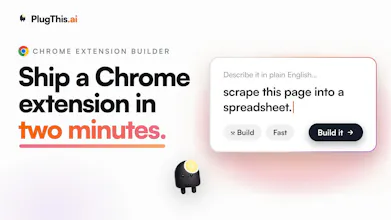
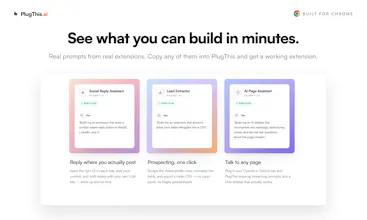
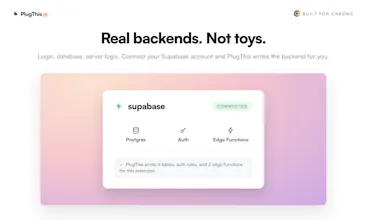
Got an idea for a Chrome extension? Describe it in plain English and PlugThis builds it. Real code, a real backend, ready for the Chrome Web Store. Refine it just by chatting. Connect Supabase for login and a database. Every change is saved as a version, so nothing is ever lost. When you're ready, we generate the icons, screenshots, and listing copy the store asks for. Everyone else builds web apps. We build Chrome extensions. That is the one thing we do.





Forum Threads


View all
Honest question: Claude Code or Codex can already build Chrome extensions better than it , with unlimited revisions and customization. What's the real differentiator here — what's the magic that those general-purpose tools can't replicate? And are you ready to survive that race? I love innovation, but if the existing giants can do the same thing better and cheaper, it's hard to justify investing time in a niche tool. I think you understand where I'm coming from, but I'm genuinely curious to hear your answer. Thanks!
@riponcm Fair question, and I'd rather answer it straight than dodge it.
You're right that Claude Code and Codex can write extension code, and for a developer who already lives in a terminal and wants maximum control, that's a genuinely great path. I'm not going to pretend we out-code a frontier coding agent at raw flexibility. So the differentiator isn't "we generate better code." It's that we're not really in the codegen business, we're in the "get a published extension" business.
Three things that gap covers:
First, the user. Claude Code assumes you're a developer with Node, a build setup, and the patience to wire tooling. A huge number of people with a good extension idea can't or won't do that. For them a general agent isn't a cheaper option, it's a non-starter. We meet the person who says "I don't really code" and still get them shipped.
Second, the last 10%, which is where extensions actually die. A general agent hands you code and stops. It doesn't scope your permissions and flag the ones you declared but never use, doesn't give you a live preview of your popup and side panel without loading unpacked, doesn't write your Chrome Web Store listing, permission justifications, and privacy disclosures, and doesn't publish to the store for you. That whole pipeline is the part people abandon, and it's Chrome-specific, not general coding.
Third, purpose-built means fewer wrong turns. Reviewers on this very launch mentioned general LLMs hallucinating manifest v3 configs and handing back outdated structures. Because we only do one thing, the output stays pinned to current MV3 rules, validated and sanitized, so you spend less time debugging setup and more time on your actual idea.
On surviving the race: general agents will keep getting better, and honestly that helps us, because our value was never the token generation. It's the opinionated, end-to-end workflow around a specific outcome. A frontier model is a better engine, but most people don't want an engine, they want the finished car, plus someone who knows exactly how to get it past inspection.
Different job, different user. I think that's a defensible place to stand, and I appreciate you pushing on it.
Chrome extension generation by chatting is a neat angle. The part I'd worry about as a user is permissions review — it's easy for an extension to ask for too much. Do you show a plain-English diff of requested permissions before build/export?
@xiaosong001 Good instinct to worry about that, it's exactly the failure mode we wanted to avoid.
Yes, before you publish you get a plain-English breakdown of every requested permission, with a reason for each one generated from your actual code, not a generic template. So instead of a raw manifest list, you see "this permission is here because the code does X," and you can edit any of it before it goes out. On top of that, any permission the manifest declares but the code never actually uses gets flagged as "no code usage found, consider removing," so over-asking gets caught rather than justified.
Good idea. It would be even better if your service somehow helped with the promotion and marketing of extensions, because this is much more difficult than development, especially in our time
@maxim100000 You bring up a really good point, our current focus is building the best chrome extension builder in the world. Helping our users move from idea to working extension, as soon as possible.
On the marketing front, we do assist with asset creation and deployment of updates to the chrome store.
We also help getting the extension ready for a chrome store listing.
On the distribution front, we havent made any plans yet, if you have any ideas please share.
This is a great idea. Does the app publish to chrome store directly post building ?
@neosrix Thanks Srix. Yes, it does.
Once your extension is built, you connect your Chrome Web Store account once, and PlugThis uploads and publishes directly from inside the app. It also generates the listing description, permission justifications, and privacy disclosures the store asks for, so you are not filling that out by hand. After the first publish it remembers your Store item ID, so pushing an update later is basically one click.
The only parts that stay on Google's side are the one-time developer account registration and the review itself, since approval is always their call. Everything up to hitting submit, we handle for you.
Congratulations on the launch ! It is really an awesome product. I used it to create an hourglass timer for my kid who can't tell time yet. I could easily change the UI and make other changes to the extension. Was really surprised at the overall design and quality of the result. Is the mobile app on the roadmap? @nefer_ai
@nefer_ai @sonal_waghchoure This genuinely made me smile, thank you so much 🙏 Really glad the design and quality held up, and that changing the UI felt easy.
On mobile: quick honest nuance, because "mobile app" can mean two things. If you mean building extensions from your phone, making the builder itself work well on mobile is very doable and worth considering. If you mean the extensions running on mobile, that's trickier, since Chrome on mobile doesn't really support extensions the way desktop does, so that limit is on the browser side, not us.
Which one were you picturing? That tells me a lot about how to prioritize it.
@nefer_ai @saurabh_dey1 Either of the two is a way to use it on a mobile. A mobile Chrome extension or a quickly deployed APK. For a simple app that I made, it made sense to use it on a phone anywhere rather than sticking to a laptop.
@nefer_ai @sonal_waghchoure That's a really sharp way to frame it, and honestly a direction I had not weighted enough until you said it.
You are right that the two paths are different beasts. A mobile Chrome extension is largely blocked by the browser itself, Chrome on Android just does not run extensions like desktop, so that one is not really ours to fix. But the APK idea is the interesting one. For a simple, self-contained tool like your hourglass timer, the logic does not actually need to be a browser extension at all. It could be exported as a lightweight standalone app or PWA you install on your phone and use anywhere.
That is genuinely a different build target than what we do today, we generate Chrome extensions, but it is a smart adjacent direction: describe a simple tool, get it as an extension for desktop AND as a mobile app for your phone. The fact that you naturally reached for "just let me use my thing on my phone" tells me a lot, because that is exactly the friction worth removing.
Noting this properly. Thank you for pushing on it, and for the hourglass timer, that is still my favorite thing anyone has built with it.
This looks cool! Does it support complex extensions with multiple pages?
Hi @pixori We can build complex multi page extensions, do you have any particular idea you want to see as an extension?
@nefer_ai For example - a multi-page extension that pulls prices from several open tabs into one live comparison panel
@pixori I was able to get this done in 2 prompts. The extension fetches data from 3 open tabs and price compares yogurt and presents findings in a new tab.
@nefer_ai This is crazy!
Been sitting on a Chrome extension idea for probably a year now and never touched it because I don't really code. The Twitter ICP scoring one you mentioned is basically the exact vibe of the thing I've wanted to build. Gonna actually try this today instead of letting it rot in my notes app lol.
@mshen316 This is the exact person we built it for, Michael 😄 A year in the notes app is long enough, today's the day.
And good news, the Twitter ICP scoring idea is right in the sweet spot: read the profile or timeline, score it against your criteria, show the result inline. You describe it in plain English and it figures out the structure, the permissions, and the scaffolding for you, so not really coding is not the blocker it used to be. You can refine it just by telling it what you want changed.
One tip: start with the simplest version of the idea, get that working and seeing it live, then add the fancy scoring logic. Momentum is everything, and this time you won't lose it to setup.
Go build it, and please come back and tell me how it went. Genuinely rooting for you on this one.