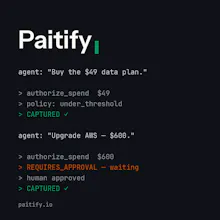
AI agents ask Paitify before they pay: instant approve/deny against your policies, human in the flow, and a tamper-evident audit trail of every decision. Rail-agnostic, MCP-native, works with Claude. Never moves your money.
Framer AI AgentsDesign and publish professional sites with AI
Promoted
Maker
📌
Hey PH 👋
Solo founder here!
I built Paitify nights and weekends around my day job as a product engineer.
The itch: AI agents are about to get spending power, the payment networks are building the rails, and anyone running agents against paid APIs has felt the question coming: what happens when the agent can buy things? Right now the answers are "give it your card and pray" or "approve every $3 purchase manually." I wanted a third option to exist before this gets big, not after.
Paitify sits between the agent and the payment. The agent asks before it pays: "can I spend $600 at AWS?" Paitify checks your policies, thresholds, merchant rules, monthly caps and answers instantly. Spends under your threshold auto-approve; big ones wait for a human tap in the dashboard. Every decision lands in a hash-chained, append-only audit log.
The deliberate design choice: Paitify never moves money. No custody, no card issuing, no rails. It's a decision-and-evidence layer, which keeps it unregulated and rail-agnostic, works the same whether the agent pays by card, bank, or crypto.
Try it without signing up: the homepage has a live policy playground, and there's a 90-sec demo of Claude trying to authorize things through it. If you use Claude, you can connect the MCP server (connect.paitify.io/mcp) and authorize a spend right now.
One design point worth being upfront about: today the integration is cooperative, the agent's side calls Paitify. But approvals are JWT-signed and verifiable offline, which means the enforcement point can move to where it belongs: the thing executing the payment checks for a valid authorization, independently of what the agent claims. That's the roadmap, and it's why the signed-token design exists.
What I most want from this thread: if you'd let an agent spend real money, what would it take for you to trust it? Building this solo, and every answer here genuinely shapes what I build next.