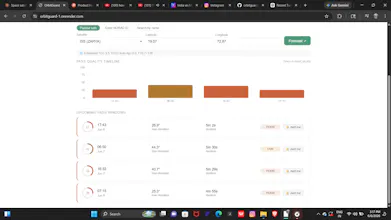
Most satellite tracking tools tell you when a pass happens. OrbitGuard tells you how good it will be. A geometrically perfect pass during a geomagnetic storm is operationally useless. OrbitGuard scores each pass 0–100 by combining elevation, duration, Kp index, solar flux, and ionospheric TEC. One actionable number instead of cross-referencing five separate sources. Built using the same data sources professionals rely on — Skyfield, NOAA SWPC, and Space-Track.org.
No reviews yetBe the first to leave a review for OrbitGuard
Maker
📌
I'm Nilabh, an MSc Physics grad who spent months reading about satellite operations and space weather. I kept noticing the same problem: ground station operators were manually cross-referencing Kp index, solar flux, ionospheric data, and orbital geometry from five separate sources just to figure out which pass windows were actually worth attempting.
The frustration was obvious — a geometrically perfect pass during a geomagnetic storm is operationally useless. But there was no single tool that combined space weather awareness with pass forecasting.
So I built OrbitGuard independently over the past few months. The core idea is simple: score each upcoming pass 0–100 by combining elevation angle, duration, Kp index, solar flux F10.7, and ionospheric TEC into one actionable number.
I'm launching here because I think this could genuinely help university CubeSat teams and ground station operators. But I also know I'm missing perspective from people who actually schedule satellite passes for real operations.
What's your biggest pain point when scheduling communication windows? What would make this actually useful in your workflow?