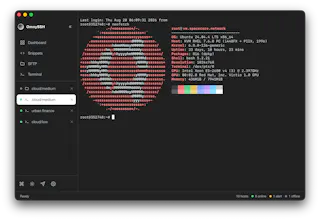
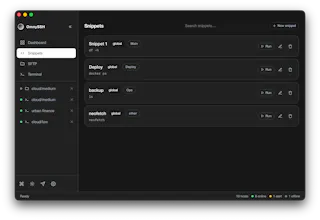
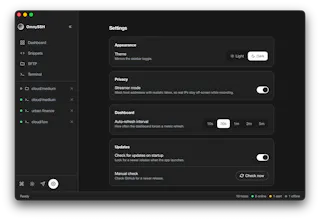
I wrote OmnySSH in Rust and Tauri to replace Termius for my daily work with servers, and it ships at 11MB. Each host is a live card with CPU, RAM, disk and uptime, pulled over the SSH connection you already have, so nothing gets installed on the server, and one click sets up an Ed25519 key and turns off password auth. None of the IPs in the screenshots are real: I built a streamer mode that swaps addresses for random ones so I can record my own VPS and my clients without exposing them.
I build websites and AI integrations, which leaves me working across dozens of servers running client projects, so Termius sat open on my Mac all day. Over time the cost of that started to bother me: an Electron app holding 649MB of RAM to keep a list of hosts and a few SSH sessions, with most of the features I wanted sitting behind a subscription. I wrote the TUI version of OmnySSH in Rust instead. It picked up around 300 stars faster than I expected, people filed issues and sent me PRs fixing Windows bugs I had no machine to reproduce. I never meant the project to stay in the terminal though. I like building interfaces people enjoy using, so the TUI became a way to harden the core on real users and have it ready for the day I shipped a GUI.
That day came this summer. The GUI runs on Tauri and SvelteKit over the same Rust core, comes to 11MB on disk and idles at 132MB of RAM.
The part I use every day is the dashboard, where each host is a live card with CPU, RAM, disk and uptime, pulled over the SSH connection you already have and with nothing installed on the server. Snippets handle the commands I type over and over: save one, then run it on a single host or broadcast it to all of them at once. File transfer happens in a two panel SFTP view, so I no longer drop back to scp for every file I need to move.
Key setup got the most care of anything in the app. One click generates an Ed25519 key, appends it to authorized_keys without rewriting what is already there, opens a fresh connection to confirm the new key works, and only then offers to turn off password auth. Two details matter here, because this is the operation people are least willing to hand to a tool. OmnySSH cannot lock you out of your own server: it never disables password auth before logging in with the new key on a separate connection, it backs up sshd_config before touching it, and it restores that backup if any step fails. Your existing keys on your local machine also stay untouched, since nothing in the codebase writes to them or deletes them.
None of the IPs in the screenshots are real. I record videos of my work and used to blur client addresses in the editor, so I added a streamer mode that swaps every address for a random one while I capture the screen.
There is no account and no telemetry anywhere in the app, and your hosts live in a plain TOML file you can commit to git. The code is Apache 2.0 at github.com/timhartmann7/omnyssh. I will answer questions through the day as I get to them, on the Rust core or the Tauri build.