
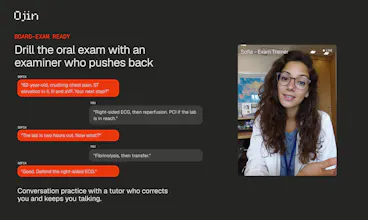
Human AI Agents have a real face and a real voice, and run live conversation rather than turn-based exchange. Interrupt mid-sentence, trail off, talk over it, and the endpointing holds. Setup is one still photo, a persona and a voice. No rig, no capture session, no script. Two face models behind a single API. Portrait for scale, Presence for expressiveness. Both drop into Pipecat and LiveKit. Try to interrupt it. Most demos cannot survive that, and it is the fastest way to judge this one.




Free
Launch tags:Artificial Intelligence
Launch Team

Viktor.comAn AI coworker that actually does the work
Promoted
Hi Product Hunt. I am Mio, founder of Ojin.
I have sat through a lot of AI demos where the face looks perfect but the conversation is unstable.
You say something, it waits. You pause to think, it talks over you. You interrupt, and it finishes its sentence anyway.
Everyone nods and nobody says the obvious thing, which is that this is not a conversation.
So we built Human AI Agents.
What it is
One still photo, a persona written in plain language, and a voice. You get an agent you can talk to and interrupt.
What runs underneath
Two face models behind a single API. Portrait for speed and scale, Presence for expressiveness. Both stream over WebSocket and drop into Pipecat or LiveKit.
What we actually spent the time on
Turn-taking. Knowing when someone has finished a sentence rather than paused to think. It is the unglamorous part and it is most of the product.
Try to break it. Interrupt it mid-sentence, talk over it, trail off, use an accent, most of all have fun!
I'll be around all day.
Congrats on the launch@iammio quick question on the silence detection did background hum/mic noise cause false triggers during testing?
@vikramp7470 Thanks Vikram! The hardest part wasn't tuning any single detector - it was finding one silence-detection approach that held up across every scenario we throw at it. We tested on-device VAD, cloud-based VAD, and external providers like ai-coustics and Deepgram, and each shined in some conditions and fell apart in others. No single method was robust everywhere. What finally worked was a combination of them rather than picking a winner - leaning on different signals depending on the context. Getting that blend to behave consistently was the real grind.
Congrats on the launch! I use LemonSlice right now but am always open to new providers. Do you have a differentiator?
@cbennettstpete Modularity is probably the bigger one: You bring your own STT, LLM and TTS, and you can swap any of them, so you're not locked into our stack for the parts you already have opinions about. After that, scale and track record: hundreds to a thousand-plus parallel conversations, 70+ languages, a 98 NPS and an average interaction time of about 21 minutes on live deployments. Real-time is the third thing, try interrupt it mid-sentence and see whether it picks up your point.
@ojin excellent, thank you!
Congrats on the launch! Had a lot of fun with the API portal so far.
@christopher_carvalho Thanks Christopher, that is really good to hear. The API portal took a while to get right so it means a lot. What are you building with it?
Happy to have contributed to this as a product engineer. It's been a wild few months of building, and it's great to finally see people trying what we made. Huge respect to the team, genuinely talented and great people to build with. Let's go! 🚀
@aaron_jablonski The turn-taking work was the hard part and most of it was yours, Thanks Aaron.
So happy to see Ojin out today after all the hard work! Proud to work with this team 🔥
@seema_chhokar Thank you Seema, long road to today.
Proud and honored to be a part of the Ojin team. Hard work do pay off. Congratulations to everyone at Ojin. My favourite is Presence. 🤩
I'm very excited to finally have Ojin released!! A lot of engineering efforts went into making this product possible and I'm so proud of the team. Can't wait for people to try it out!