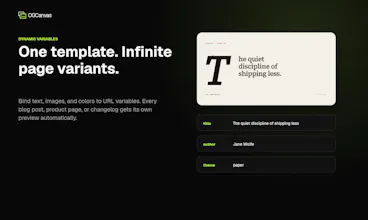
OGCanvas turns one design into every Open Graph image your site needs. Create a polished 1200×630 template in a visual editor, make text, images, and colors dynamic, then use one hosted render URL to generate a unique preview for each page. Start with 30 templates, preview links across social platforms, and export PNG, JPEG, or WebP. Free to design and download - no watermark or credit card required.
No reviews yetBe the first to leave a review for OGCanvas
Hunter
📌
Hey Product Hunt! 👋
I’m Nitesh, the maker of OGCanvas.
I built OGCanvas because Open Graph images are usually treated as a last-minute task. Developers either use the same static image everywhere, build and maintain their own rendering system, or manually create a new image for every page.
I wanted a simpler workflow: design a template visually, make parts of it dynamic, and use one hosted URL to generate a unique social preview for every blog post, product page, launch, or changelog entry.
With OGCanvas, you can:
• Design polished 1200×630 images in a visual editor
• Start from 30 ready-to-use templates
• Add dynamic text, images, colors, and themes
• Preview how your link looks across social platforms
• Export PNG, JPEG, or WebP without a watermark
• Generate per-page images from a hosted render URL
OGCanvas is free for designing and downloading. Premium is $5/month for unlimited designs, every template, a brand kit, and the hosted render URL.
I’d really appreciate your feedback- especially on the editor, templates, and dynamic URL workflow. What would make OGCanvas more useful for your website?
Thanks for checking it out! ❤️
Report
the one-hosted-render-url part is what caught my eye, since it means the image is generated at request time rather than baked at build time. curious how you handle crawler caching though - twitter/linkedin/facebook all cache the og image aggressively once they've scraped a url, sometimes for days. if the underlying data behind a render changes (price update, headline edit, whatever), does the old cached preview just stay stale on those platforms until someone forces a re-scrape, or is there a way around that built in?
Report
the per-page dynamic rendering beats baking images at build time for sure. one thing I'd want to know before wiring this into a blog with a lot of posts - if I go back and tweak the template later (swap a color, change a font), does that retroactively change every already-generated render url that uses it, or does each page freeze at whatever the template looked like when it was first generated? asking because a small design tweak silently changing hundreds of live social previews at once could be a fun surprise in either direction
Report
Tried it with a simple blog template and the dynamic text fields actually worked as advertised when I swapped the URL params. The export options being free without a watermark is a nice touch, didn't expect that.
I built an OG image pipeline for my own site so I appreciate what you're doing here. The thing that surprised me most wasn't rendering, it was caching. Social crawlers hold onto old images long after you regenerate them. Does OGCanvas handle cache busting on the hosted render URL, or is that left to the user?
the one-hosted-render-url part is what caught my eye, since it means the image is generated at request time rather than baked at build time. curious how you handle crawler caching though - twitter/linkedin/facebook all cache the og image aggressively once they've scraped a url, sometimes for days. if the underlying data behind a render changes (price update, headline edit, whatever), does the old cached preview just stay stale on those platforms until someone forces a re-scrape, or is there a way around that built in?
the per-page dynamic rendering beats baking images at build time for sure. one thing I'd want to know before wiring this into a blog with a lot of posts - if I go back and tweak the template later (swap a color, change a font), does that retroactively change every already-generated render url that uses it, or does each page freeze at whatever the template looked like when it was first generated? asking because a small design tweak silently changing hundreds of live social previews at once could be a fun surprise in either direction
Tried it with a simple blog template and the dynamic text fields actually worked as advertised when I swapped the URL params. The export options being free without a watermark is a nice touch, didn't expect that.
@rza1192250 Thanks for checking out
I built an OG image pipeline for my own site so I appreciate what you're doing here. The thing that surprised me most wasn't rendering, it was caching. Social crawlers hold onto old images long after you regenerate them. Does OGCanvas handle cache busting on the hosted render URL, or is that left to the user?