Hi Noodlers!
Big week . Here's what happened!
Your Halo is here
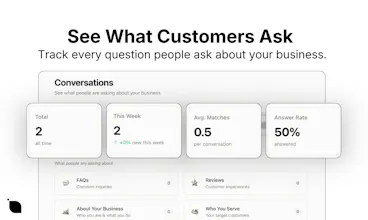
We shipped it. Halo is your AI assistant, embedded directly on your website. Customers ask questions. Halo answers. They book appointments. Halo handles it. One script tag, 5 minutes, done.
Noodle Seed
Hi Product Hunt! 👋
We built Noodle Seed because software teams are being asked to add AI agents and agent interfaces, but one useful workflow can quickly turn into an infrastructure project. Teams end up rebuilding identity, permissions, secrets, rate limits, audit, hosting, and multi-tenancy before customers can get real work done.
Noodle Seed lets you start with a secure, customer-branded assistant inside your existing SaaS. It uses the product workflows, identity, data, and business rules you already trust. It’s industry-agnostic, so you can build conversational experiences for travel, e-commerce, restaurants, financial services, healthcare, or virtually any other vertical.
Developers define capabilities in TypeScript, prove them locally for free, and deploy them to a governed runtime. The same workflows can then expand to ChatGPT, Claude, Codex, and other MCP clients when customers need them.
Our goal is simple: make your software ready for agents without replacing the product behind it. We’d love to hear which customer workflow you would make conversational first.
PicWish
@asadatnoodle nice launch!
I'm wondering how minified react components render across different mcp clients.
if the client can't render the ui elements,does it fall back to plain text schemas ?
Noodle Seed
@mohsinproduct Thanks! The react ui is bundled as html/js and rendered in a sandboxed iframe by clients that support mcp apps (which comes out of the box with noodle seeds embedded assistant). For clients without UI support, the tool still return text and structured data, so the agent can continue the conversation. The fallback is the underlying tool result, rather than converting react into txt schemas.
@asadatnoodle avoiding all the framework work around MCP sounds like a big time saver for team,
Congrats on the team!
Noodle Seed
@amrita_prajapati2 Thank you!!
Noodle Seed
@asadatnoodle @amrita_prajapati2 Thanks for the positive feedback, Amrita. We'll be keen to hear your team's feedback on the developer experience on our platform!
I like the idea of customers browsing products directly inside an AI conversation. Can the experience also handle more complex purchase or booking flows?
Noodle Seed
@1mirul Absolutely, it can!
We built the entire stack around the ability to showcase React-based components to the user, so we could not only show the products but also complete entire workflows and transactions right inside the AI conversation. Whether that conversation happens on your website, inside your web application, inside your mobile application, or inside someone's ChatGPT or Claude, the same capability can be delivered across all channels.
Do you sample the same prompt more than once?
Noodle Seed
Wion - Audio Dating
I’m curious how much control businesses have over the AI apps responses. Can we define specific rules or guardrails for how it represents our brand?
Noodle Seed
@tanjum yes and there are a few ways of doing this actually. We have baked in the ability to add a knowledge base document to your assistant which instructs and defines guard rails for the AI assistant on business rules, FAQs or any other relevant information. Moreover, you can also define an agent guide which is a skill that you can deploy alongside your MCP app and whenever you connect your MCP URL to any agent, it will receive that skill as well which helps it make better decisions around the tool usage and improve the overall conversational user experience.
Noodle Seed
@tanjum There are a number of ways the AI can be guided to represent your business or your brand the way you would like. For example, skills, knowledge bases, instructions, etc.
The most deterministic thing under your control would be small, minified user interface elements that can be sent over the wire to the user. Those elements are 100% deterministic and can be set up at the time the AI agent or the application being served through the AI agent is set up.
Even if the user is on Claude or ChatGPT, whenever one piece of user interface is sent to the user, it will always show exactly what you want: the same colors, the same font, and the same brand identity as you wish.
Would love to hear what kind of use cases you have in mind.
Making an existing product usable through AI without rebuilding the whole product around agents is really interesting... Do customers usually ask for specific workflow or do you find that some workflows work better conversationally than others?
Noodle Seed
@harini_mukesh Usually, customers start with an outcome, not a specific workflow: “Let me check inventory and place an order from ChatGPT.”
The workflows that translate best are frequent, well-bounded tasks where the intent is clear but the inputs vary. Search, lookups, updates, approvals, and simple multi-step actions work well conversationally. Dense visual work or high-risk actions still benefit from the existing product UI, with AI helping users get there faster rather than replacing it.
Noodle Seed
@harini_mukesh It’s usually a mix. Some customers arrive with a specific workflow in mind, but often we help identify the best place to start.
The strongest conversational workflows tend to be goal-based, easy to describe in plain language.
Some workflows naturally work better conversationally- especially tasks where users know the outcome they want but not necessarily the steps to get them there.
Noodle Seed
Hi Product Hunt,
I'm Fahd, from Noodle Seed. I noticed that I myself never purchase any software that doesn't already have an MCP connector for my Claude or Codex. I thought every single software product out there would need to provide this as a table stake. As we started building a platform around it, we realized that not only can we bring people's software into AI agents, but we can also bring AI agents into people's software because we are providing this platform-level connectivity. And if we can put it inside software, we can put it on any publicly facing website as well for pretty much any type of business.
A restaurant able to take orders conversationally on their website, an online travel agency accepting travel bookings in ChatGPT, and B2B software that is transactable right inside employees' Claude all require the same building blocks of MCP skills, credential brokering, OAuth, rate limiting, and all the rest.
We expect all builders to build this capability on top of their own products, just the way we build products using our AI coding assistants. We optimized our entire stack to be buildable with your own Claude Code or Codex, or your favorite AI coding tool.
Today is the day we put it out there in front of all of you to get some real-world feedback and understand whether what we are building is indeed headed in the right direction.
Are there certain features that would be more important?
What kinds of use cases would you build this for?
How could something like this help you grow your business?
I am always happy to connect. Please find me on LinkedIn. I would be happy to share my personal calendar scheduling link with you.
Kind regards,
Fahd
CheckYa
The compelling aspect here is not merely creating an AI agent but rather transforming the very point where the customer journey concludes. If conversation evolves into the new 'search interface,' this appears to be a perfectly natural progression.
Noodle Seed
@monir_ I second that. There is a paradigm shift around user behavior as far as 'search interfaces' go. Agents are no longer question and answer bots anymore, they can take action and its only time when people will have to cater for this on their website, in their processes and workflows or overall operations.
We at Noodle Seed really believe in this and want to empower people to prepare for this wave by giving them as much technical flexibility as possible and enabling agent first experiences.
Noodle Seed
@monir_ An interesting point: we believe the conversation does not only evolve into the new search interface, but rather becomes a two-way, transactional interface, not a one-way interface or a one-way information interface, the way search used to be. People can not only ask for information but also complete entire transactions right inside the conversation, whether it's booking appointments, purchasing tickets, opening support cases, or anything else.
Would love to hear what use case you have in mind?