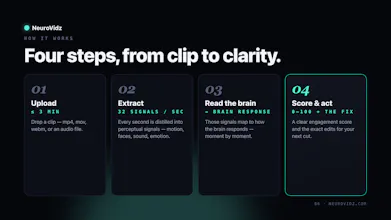
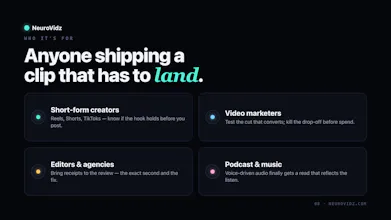
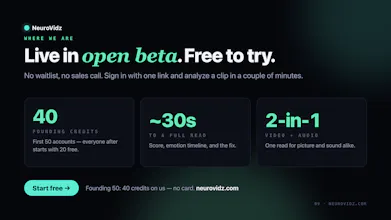
Upload a video or audio clip. In about a minute, NeuroVidz maps how a brain would respond to its picture AND its sound — an engagement score that shows its components, a per-second emotion timeline, and timestamped suggestions for your next edit. Most tools focus on the frames alone; NeuroVidz listens too, so podcasts, music, and voice-driven clips score like a listener feels. If it can't produce a confident read, it refunds the credits. Start free, no card — founding 50 accounts get 40 credits.
No reviews yetBe the first to leave a review for NeuroVidz
One thing I'd love is the ability to compare two versions of the same clip side by side, so I can see how a re-edit changes the engagement score and emotion timeline. Would make A/B testing hooks and thumbnails way easier.
@naze6eq This has quickly become the most-requested feature of launch day, and it's earned its spot at the top of the post-launch list: two cuts of the same clip, timeline against timeline, score against score. One scope note — the engine reads moving picture and sound, so thumbnails themselves are outside what it can score, but hook-vs-hook comparison is exactly the use case we're building for. Thanks!
Report
The audio-aware angle is genuinely interesting, since so many tools ignore the sound side. One thing that would help me decide if it's worth using long-term though is some kind of comparison view, so I can drop in two versions of the same clip and see how the engagement scores and emotion timelines actually differ. That would make the suggestions feel way more actionable instead of just a score in a vacuum.
@aslhanfv73 Thank you — and you've named exactly why we're building it: a score you can act on is a score you can compare. A comparison view has been the most-requested feature all day.
Report
Is it that Meta model behind this product or what are you using?
@divya_kothari1 No — the engine that runs is our own, not a third-party foundation model.
Under the hood: we measure 25+ properties of the picture and sound each second, then map them onto the seven cortical networks using weights grounded in published neuroscience. That mapping — the actual brain read — is built and calibrated in-house. The one outside piece is a commercially licensed LLM that phrases the findings into plain-language recommendations; it never computes the score.
The refund on low confidence reads is a smart call. Most analytics tools will give you a number no matter what, even when the input is too messy to trust.
@talhakhalidmtk Thanks — that's the core idea: an instrument should be able to say "I can't measure this" rather than invent a number. Every read downstream only means something if that rule holds.
I like that the product is explicit about what it measures and, just as importantly, what it doesn't claim to predict. Tools that acknowledge uncertainty tend to be much more useful than ones that always return a confident score.
@varun1jan Thanks — drawing that line early was easier than defending a blurry one later. The sharpest comments on this page all probed exactly where the boundary sits, which tells us creators want a tool that knows its limits more than one that promises everything.
Report
El producto es bueno, la parte teórica y la base científica es la que se debería mostrar de mejor manera, me imagino que es deep learning de una base de datos enorme de EEG.



One thing I'd love is the ability to compare two versions of the same clip side by side, so I can see how a re-edit changes the engagement score and emotion timeline. Would make A/B testing hooks and thumbnails way easier.
NeuroVidz
@naze6eq This has quickly become the most-requested feature of launch day, and it's earned its spot at the top of the post-launch list: two cuts of the same clip, timeline against timeline, score against score. One scope note — the engine reads moving picture and sound, so thumbnails themselves are outside what it can score, but hook-vs-hook comparison is exactly the use case we're building for.
Thanks!
The audio-aware angle is genuinely interesting, since so many tools ignore the sound side. One thing that would help me decide if it's worth using long-term though is some kind of comparison view, so I can drop in two versions of the same clip and see how the engagement scores and emotion timelines actually differ. That would make the suggestions feel way more actionable instead of just a score in a vacuum.
NeuroVidz
@aslhanfv73 Thank you — and you've named exactly why we're building it: a score you can act on is a score you can compare. A comparison view has been the most-requested feature all day.
Is it that Meta model behind this product or what are you using?
NeuroVidz
@divya_kothari1 No — the engine that runs is our own, not a third-party foundation model.
Under the hood: we measure 25+ properties of the picture and sound each second, then map them onto the seven cortical networks using weights grounded in published neuroscience. That mapping — the actual brain read — is built and calibrated in-house. The one outside piece is a commercially licensed LLM that phrases the findings into plain-language recommendations; it never computes the score.
Happy to go deeper — full write-up at neurovidz.com/methods.
The refund on low confidence reads is a smart call. Most analytics tools will give you a number no matter what, even when the input is too messy to trust.
NeuroVidz
@talhakhalidmtk Thanks — that's the core idea: an instrument should be able to say "I can't measure this" rather than invent a number. Every read downstream only means something if that rule holds.
NINA
I like that the product is explicit about what it measures and, just as importantly, what it doesn't claim to predict. Tools that acknowledge uncertainty tend to be much more useful than ones that always return a confident score.
NeuroVidz
@varun1jan Thanks — drawing that line early was easier than defending a blurry one later. The sharpest comments on this page all probed exactly where the boundary sits, which tells us creators want a tool that knows its limits more than one that promises everything.
El producto es bueno, la parte teórica y la base científica es la que se debería mostrar de mejor manera, me imagino que es deep learning de una base de datos enorme de EEG.