Most AI remembers you on someone else's server. SovereignAI runs on yours: one zero-dependency binary, no account, works offline. What's different — every memory carries a receipt: how it entered, which conversation it came from, which model wrote it. Deleting zeroes the bytes. Your exit is a checksummed, encryptable export you can verify without importing it anywhere. Local open weights by default. Rent a frontier model only when you choose, disclosed on screen.
Hey Product Hunt 👋
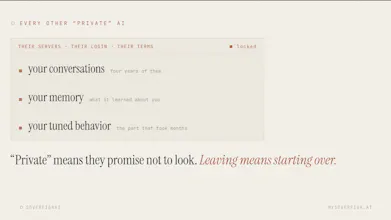
I kept noticing the same thing: the AI tools I relied on were getting
better at knowing me, and that was exactly the problem. Years of
conversations, preferences, the shape of how I work — all of it living on
servers I don't control, in formats I can't take with me. Not because
anyone is evil. Because that's the business model. The moat is the memory.
Then I looked at where the rest of "me" actually lives: email, bank
exports, health records, receipts, calendars, a dozen AI chat histories.
You are the most fragmented database on earth. And the joins that would
be genuinely useful — subscriptions against usage, renewals against your
calendar — are only safe if you hold both sides. Nobody can assemble that
for you safely. You have to assemble it yourself, on hardware you own.
So SovereignAI runs as one file on your machine. Zero runtime
dependencies — the code you audit is the code that runs. Local open
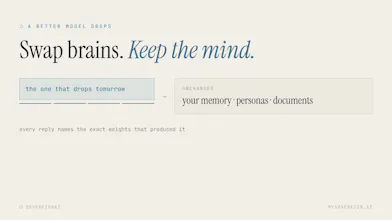
weights by default; rent a frontier model when you want it, with the
disclosure on screen when you do.
Three constraints I refused to break:
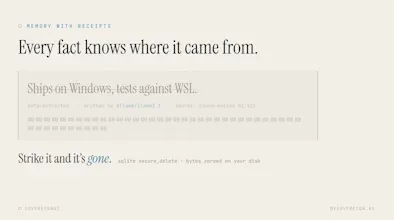
• Every memory shows its provenance — which conversation it came from,
which model wrote it. If we can't say where a memory came from, we
don't keep it.
• Deleting deletes, down to the bytes.
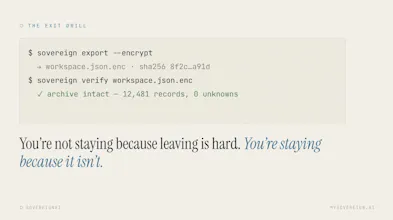
• The exit is a feature, not a promise: one checksummed export, encrypted
with a passphrase only you hold, verifiable without importing it
anywhere. The format is documented well enough to outlive us.
How it evolved: the first version was a really good chat window, and that
was the mistake. Chat made the data plane invisible — you couldn't see
what it knew about you or where that came from. So the default view
became the mind itself: memories with receipts, what arrived from where,
which doors are open. The chat is now the least interesting part.
Two honest notes. We're in gated early access — a person reads every
request. And the core is fair source (FSL-1.1-MIT): self-host it, fork
it, use it internally with no restrictions; each release becomes plain
MIT two years after it ships. That's not "open source," and I'd rather
say so plainly than blur it.
The question I'd genuinely like answered: which layer would you need to
own before you'd trust an AI with your actual life? Ask me anything.





Tokenomy.ai