Launching today

Moonstone
The Bloomberg Terminal for Pokémon Cards
1 follower
The Bloomberg Terminal for Pokémon Cards
1 follower
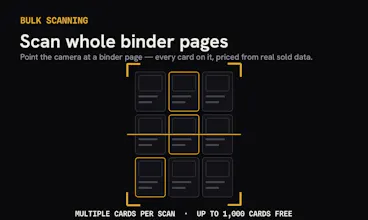
Point your phone at a binder page and Moonstone prices every card on it from real sold data — no typing, no one-card-at-a-time lookup. Scan 1,000 cards free: moonstonehq.com/scan Under the scan: eBay sold-price medians, PSA populations and gem rates, each figure with its source, across 70,045 cards. Plus break-even grading math — the exact gem rate where grading starts to pay, and a plain "sell it raw" when it doesn't. Pro: free 3 days, then $9.99/month.



Hey Product Hunt — I'm Don, I built Moonstone.
It started with my binders. Like most collectors, I had pages and pages of cards I'd never priced, because looking up values one card at a time is nobody's idea of fun — so the binders just sat there, value unknown. So the first thing I built was the binder scan: point your phone at a binder page — multiple cards, whole binder pages — and Moonstone prices every card on it from real sold data. No typing, no one-card-at-a-time lookup. Scan up to 1,000 cards free — try it at https://moonstonehq.com/scan.
The pricing underneath matters as much as the scan. I kept making the same expensive mistake: deciding whether to grade a card by gut feel and whatever the highest asking price on eBay said. Asking prices are fiction. So Moonstone is built entirely on what cards actually sell for — eBay sold medians with the sales behind each figure, PSA populations, real gem rates.
And it does one number I couldn't find anywhere: the break-even gem rate. Moonstone adds up what grading really costs (the raw card, grading, shipping, selling fees) and weighs it against PSA 10 and 9 sold medians, then tells you the exact gem percentage where grading starts to pay. Lugia V 186, for example: break-even is 15%, its actual gem rate runs about 39 points above that — grade it. Plenty of popular cards fail the same test, and Moonstone will tell you to sell those raw instead. It's arithmetic, not advice, and it regularly argues against grading.
Underneath it all sits the full terminal: a catalog of 70,045 cards, live movers boards, and set indexes — so you can see what's running across the market before you ever open a binder.
Pro (deeper data) is free for 3 days, then $9.99/month.
I'd genuinely love feedback: what set should we deepen next, and what metric do you wish existed? I'll be here all day answering everything.