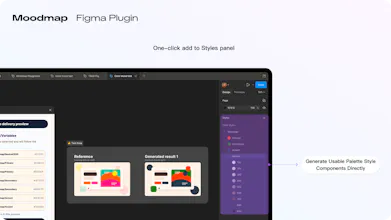
Moodmap is a Figma plugin that turns mood prompts and visual references into structured UI color palettes. Designers can define brand tones or upload reference images to auto-generate organized palettes with primary, secondary, accent, and neutral colors. It supports palette comparison, regeneration, color locking, and saving. Apply custom palettes instantly as Figma color styles and light/dark variables to streamline UI exploration, brand tuning and design system setup.
No reviews yetBe the first to leave a review for Moodmap
Maker
📌
Thanks for checking out Moodmap.
I’d especially love feedback on three things:
1. Whether the generated palettes feel usable in real UI design work
2. Whether the mood prompt flow feels natural
3. What you would expect from a future “apply to selected frame” workflow
Really appreciate any thoughts or suggestions.
Report
love how it breaks the palette out into primary, secondary, accent and neutrals right away instead of just dumping a wall of swatches. the color locking when regenerating is a really thoughtful touch for actually iterating on a vibe.
Report
Maker
@turkanunuv95635 Thank you so much — this really gets at what I wanted Moodmap to do.
A big goal for the plugin was to move beyond a flat wall of swatches and make the output feel usable in real UI work, so breaking palettes into primary, secondary, accent, and neutrals was a very intentional part of the design.
Color locking was built for exactly the kind of iterative exploration you described: keeping the parts that already feel right while still pushing the direction forward.
Really appreciate you taking the time to call that out.
Report
Being able to lock specific shades is great, but it would be even more useful if Moodmap could export the generated palettes directly as CSS variables, Tailwind config snippets, or JSON for token pipelines. That would make the handoff to developers way smoother and tie into existing design system tooling without extra cleanup steps.
Report
Maker
@bahar278467 This is a really strong suggestion — thank you.
I completely agree that export is a big part of making a tool like this useful beyond exploration. Right now, Moodmap is focused on generating structured palettes and helping designers apply them inside Figma as styles and variables, but smoother handoff into developer workflows is definitely an important next step.
CSS variables, Tailwind-friendly output, and JSON/token export are all directions I’m actively considering, especially for teams working with design systems and production pipelines.
Really appreciate you calling this out so clearly.
Report
Being able to lock individual hex values while regenerating the rest is great, but it would be even better if Moodmap could let me lock a specific hue range so the whole palette stays within a defined temperature or brand family when I hit regenerate. Would make iterating on a direction so much faster without drifting off-tone.
Report
Maker
@azrailenkmjzh Thank you — this is a really thoughtful suggestion.
I completely agree that locking individual hex values solves only part of the iteration problem. Being able to preserve a broader hue range or overall color temperature during regeneration would make it much easier to stay within a consistent brand direction while still exploring variations.
That kind of “direction lock” is very much aligned with how I’m thinking about future iterations of Moodmap, especially for faster and more controlled palette exploration.
Really appreciate you taking the time to share this — it’s a very valuable product insight.
Report
Maker
A lot of the feedback so far is pointing in two really interesting directions for Moodmap: making iteration more controllable for designers, and making export/handoff smoother for design system workflows.
Both are very helpful signals - really appreciate everyone taking the time to share thoughtful use cases.🙏
love how it breaks the palette out into primary, secondary, accent and neutrals right away instead of just dumping a wall of swatches. the color locking when regenerating is a really thoughtful touch for actually iterating on a vibe.
Being able to lock specific shades is great, but it would be even more useful if Moodmap could export the generated palettes directly as CSS variables, Tailwind config snippets, or JSON for token pipelines. That would make the handoff to developers way smoother and tie into existing design system tooling without extra cleanup steps.
Being able to lock individual hex values while regenerating the rest is great, but it would be even better if Moodmap could let me lock a specific hue range so the whole palette stays within a defined temperature or brand family when I hit regenerate. Would make iterating on a direction so much faster without drifting off-tone.
@azrailenkmjzh Thank you — this is a really thoughtful suggestion.
I completely agree that locking individual hex values solves only part of the iteration problem. Being able to preserve a broader hue range or overall color temperature during regeneration would make it much easier to stay within a consistent brand direction while still exploring variations.
That kind of “direction lock” is very much aligned with how I’m thinking about future iterations of Moodmap, especially for faster and more controlled palette exploration.
Really appreciate you taking the time to share this — it’s a very valuable product insight.