
MonoCloud for Startups
One identity layer for your customers, APIs, and agents
349 followers
One identity layer for your customers, APIs, and agents
349 followers
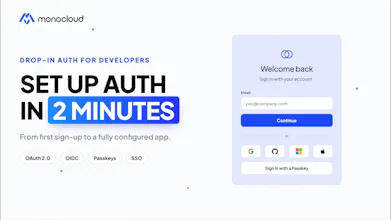
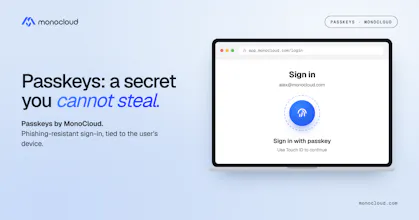
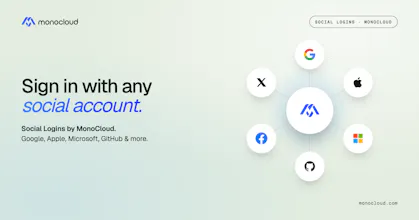
MonoCloud is one identity layer for your customers, your APIs, and your agents. Most tools stop at a login box. We go past login into authorization and accountability: decide exactly what every user, service, and AI agent can access, prove what it did, and revoke it in an instant. Fine-grained Cedar authorization, passkeys and SSO, API protection, M2M, and mTLS with certificate-bound trust, all on one platform. Startups get the full platform free for one year.





Vishal — the step-up-before-high-risk-action line caught me. If an AI agent, not a human at a keyboard, is the one about to trigger something like a payment or a live bid submission, can step-up auth even work — or does that whole model assume there's a human around to re-verify?
@medal411 Sharp catch. Classic step-up does assume a human is there to re-verify, so re-prompting a fully autonomous agent for a passkey doesn't make sense. Two things cover the agent case instead. When a human should sign off, you use human-in-the-loop consent, pausing the agent before the sensitive action and requiring a fresh approval. When it's genuinely autonomous with no human, you don't step up at all, you gate the action with policy, a Cedar rule that decides whether that agent, with that scope, is even allowed to trigger the payment, rather than re-verifying someone who isn't there.
As someone who built auth from scratch on Cognito (custom role injection, multi-tenant org isolation, MFA, OAuth flows) — I have strong feelings about this space. The pain is real, especially for startups that underestimate auth complexity on day 1. What's your migration story like for founders already locked into Cognito or Auth0?
@rachid_abadli You clearly know the depth here, custom roles and multi-tenant isolation on Cognito is exactly what people underestimate on day one. The good news is you don't rip and replace. It's standard OAuth and OIDC, so MonoCloud runs alongside what you have and you move one surface at a time, and you bring your users across programmatically through our Create User endpoint, carrying their claims plus private and public data so their properties come over from Cognito.
Honestly I'd point you to our startup program. You get the full platform free for a whole year with all the premium features, and our team will be hands-on with the migration so we can help wherever you get stuck. Past that, you get to focus on building your product instead of auth and identity. You can fill out the form here, https://tally.so/r/ZjKMKB
Hey Product Hunt 👋 Vishal here, founder of MonoCloud.
Every company is racing to put AI agents into production. Almost none of them can answer one simple question. When an agent does something it should not, who is accountable?
The log will say an agent did it. But an agent has no intent. Someone gave it that access, and today most teams cannot say who, cannot prove it, and cannot pull it back fast. That gap is the biggest unsolved problem in identity right now, and it is why I built MonoCloud.
I have built authentication into products four times over my career. Every time, the login box took a weekend and everything that mattered took months. Passkeys alone were over 800 engineering hours before they were production ready. I learned the hard way that identity is not a feature you bolt on. It is infrastructure, and it decides whether you can be trusted.
MonoCloud is that infrastructure. One platform for your customers, your APIs, and your agents, where you decide exactly what each can access, prove what it did, and revoke it in an instant.
Two convictions shaped it, and I still stand by both:
🔹 Build on open standards, not shortcuts. Authorization runs on Cedar, workload identity on SPIFFE, and trust on mTLS with certificate-bound tokens. Anyone can demo a policy dashboard. Far fewer hold up in a real security review.
🔹 Treat agents as first-class identities from day one. Every agent gets a scoped identity, acts on behalf of a user only within the limits you set, and leaves an audit trail you can revoke in one click.
All of it is live today. Ten design partners across SaaS and AI companies are building on it now.
👉 Startups get the full platform free for one year, every premium feature, no gates. Apply here: MonoCloud for Startups - Free for One Year 👈
If identity is core to what you are building, we are opening a few more design partner spots. Leave a comment or reach me on LinkedIn.
I will be here all day. The one thing I want to hear is this. How are you handling identity for your agents today, and what happens the first time one does something it should not?
Identity layer that covers customers, APIs AND agents in one place is actually pretty rare. Most solutions handles only one or two of those well. Free for a year is generous, what happens at the end?
The customers/APIs/agents split is a nice framing. When I’ve seen auth projects drag, migration is usually the painful part. Do startups get a path to adopt one surface first, or is it meant to replace the stack in one go?
@xiaosong001 Yes, one surface first is exactly how it's meant to go, no big-bang replacement. Because it's standard OAuth and OIDC, MonoCloud runs alongside your current setup, so you can start with a single piece, customer login, or just your API auth, or only the agent side, and expand from there. Users come across programmatically through our Create User endpoint, carrying their claims plus private and public data, so you're not rebuilding profiles.
And if you're early, I'd point you to our startup program. You get the full platform free for a year with all premium features, and our team gets hands-on with the migration so you're not doing it alone. You can fill out the form here, https://tally.so/r/ZjKMKB
Hey Product Hunt! 👋 Riya here. I do product marketing at MonoCloud, and I am one of the makers.
Most of my week is spent talking to founders about auth, and I keep seeing the same arc. In the beginning nobody wants to think about it, so they drop in a login box, ship, and move on.
Six months later, those same people are drowning in it.
A customer wants SSO.
A security review shows up with forty questions.
Their services need to talk to each other safely. And their AI agents are now acting on behalf of users with no real control over what they can reach.
The reason it keeps happening is that most identity tools were built for one slice of the problem.
The easy ones stop at the login screen.
The enterprise ones are powerful but slow and expensive to adopt. So teams end up owning the hard middle themselves, which is the exact part they have no time to build.
MonoCloud covers all of it on one platform, your customers, your APIs, and your agents, from your first user to enterprise scale. Not just who signs in, but what every user, service, and agent is allowed to do afterwards, with the ability to prove it and pull it back in an instant.
All of it is live today, not a demo or a waitlist. Ten design partners across SaaS and AI companies are already building on it.
👉 If you are a startup, you get the full platform free for a year, every feature, no gates. Apply here: MonoCloud for Startups - Free for One Year 👈
And if identity is central to what you are building and you want to shape where this goes, we are opening a few more design partner spots. Leave a comment or reach me on LinkedIn (link in profile).
I will be here all day and would genuinely love to know how you are handling identity for your AI agents right now, and where it falls apart first. That is the conversation I care about most.
the one year free offer for startups is honestly such a smart move, basically lets you build the whole stack without cobbling together five different auth tools.