Look beyond the vendor name. Understand MAC addresses with IEEE block data, device-category clues, privacy-randomization signals and plain-English reasoning. Use it through the free lookup, JSON API, bulk databases, log extractor, MCP or self-hosted deployment.
Hey Product Hunt 👋
I built macadress because most MAC lookup tools answer only one question: “Who registered this prefix?”
That answer is useful, but it is often not enough.
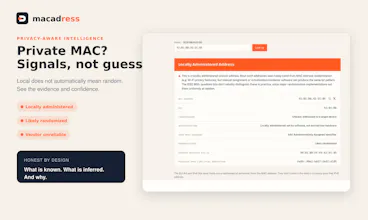
A MAC address can also tell you whether it is universally or locally administered, unicast or multicast, which IEEE block it belongs to, how large that block is, and whether the vendor result is reliable. Modern phones and laptops complicate this further by using private or randomized addresses.
I wanted a lookup that did not just return more fields, but explained what was actually known.
macadress gives you:
• Exact IEEE block matching across MA-L, MA-M, MA-S, IAB and CID
• Privacy-randomization signals with confidence and reasoning
• Vendor, block range, address capacity and registration country
• Device-category clues without pretending to know an exact model
• Modified EUI-64 and possible IPv6 link-local derivations
• Plain-English explanations and honest limitations
You can use the same data in several ways:
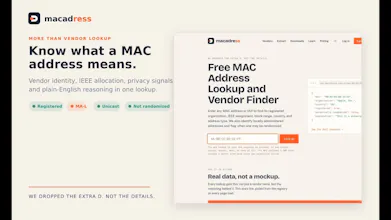
🔎 Free web lookup with no account
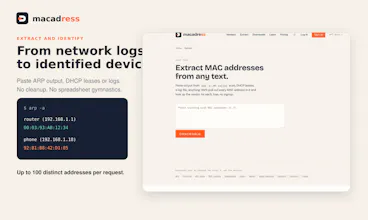
🧾 Paste ARP output, DHCP leases or logs and extract every MAC address
⚡ JSON API for single, batch and text-extraction requests
📦 Fresh CSV, JSON, Wireshark, Nmap and Cisco-compatible downloads
🤖 MCP tools for AI agents
🏠 Self-hosted deployment when addresses cannot leave your network
The underlying registry is synchronized directly from IEEE on a recurring schedule. The hosted API and self-hosted version use the same lookup engine.
The goal is simple:
Know what a MAC address means, not just who made it.
I would love to know how you currently use MAC data. Network inventory? IoT? Security? Device onboarding? Something I have not considered?
I will be here throughout the launch and would genuinely value your feedback.
APIsList