Rent cloud GPUs and call hosted AI models from one Lumino account. Use local currency pricing, per-second GPU billing, and chat, video, and speech APIs.
No reviews yetBe the first to leave a review for Lumino AI
Maker
📌
Hey Product Hunt,
I’m Dixshant, building Lumino AI.
We built Lumino because repeated-prompt LLM workloads can get expensive fast. AI tutors, legal document tools, RAG apps, support bots, and agents often send the same large context again and again.
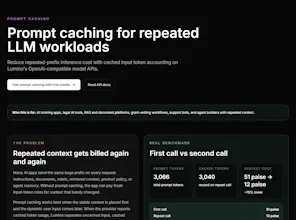
Lumino gives builders OpenAI-compatible model APIs with cached input token accounting, so repeated-prefix usage is easier to test, track, and optimize.
In one repeated-prefix test:
First call: 3,066 prompt tokens, 0 cached, 51 paise
Repeat call: 3,066 prompt tokens, 3,040 cached, 12 paise
That is about 76% lower request cost on the repeat call.
Would love feedback from anyone building AI tutoring, legal AI, RAG, agents, or document-heavy LLM products.
Report
How does the per-second GPU billing actually work when spinning up something like an A100, and are there minimum charges or cool-down periods before I can shut it down?
Report
Maker
@berra132119 Hey Berra, good question. We bill the A100 by actual runtime, not by rounding it up to an hour. There’s a 60-second minimum when the pod starts, then it’s metered per second.
You can shut it down whenever you’re done, there’s no cool-down period. Compute billing stops once termination is confirmed. If you choose “stop” instead of “terminate,” the GPU charge stops but persistent storage may keep billing until you delete the pod.
So if you use an A100 for around 5 minutes, you pay for around 5 minutes, not the full hour.
Report
How does the per-second GPU billing actually handle setup and teardown time, do you charge for that or only the inference itself?
Report
Maker
@tahsin1326739 We start billing once the GPU is provisioned and the rental becomes active. Any setup you do inside the running pod, like pulling an image or loading model weights, counts as runtime. Billing continues until termination is confirmed, so teardown is included too. Failed provisioning is refunded
Report
The per-second GPU billing is a really thoughtful touch, especially paired with local currency pricing. Makes it way less intimidating to spin up a model for a quick test.
Report
Maker
@saadetsalerzv Thanks Saadet. Quick experiments were exactly why we chose per-second billing. Paying for a full hour just to test whether a model or setup works never made much sense to us
Report
Renting a few H100s through Lumino was refreshingly painless — the per-second billing meant I didn't feel guilty spinning one up just to test a script, and paying in euros saved me the usual conversion math.
Report
The per-second GPU billing paired with local currency pricing is a really thoughtful move, especially for teams outside the US who usually get burned by FX fees. Clean execution on something most competitors ignore.
Report
Maker
@grselekicetwzh Thanks Gürsel, really appreciate that. FX fees and unpredictable conversion rates are a genuine pain here, so showing and charging in local currency was important to us from the start.
How does the per-second GPU billing actually work when spinning up something like an A100, and are there minimum charges or cool-down periods before I can shut it down?
@berra132119 Hey Berra, good question. We bill the A100 by actual runtime, not by rounding it up to an hour. There’s a 60-second minimum when the pod starts, then it’s metered per second.
You can shut it down whenever you’re done, there’s no cool-down period. Compute billing stops once termination is confirmed. If you choose “stop” instead of “terminate,” the GPU charge stops but persistent storage may keep billing until you delete the pod.
So if you use an A100 for around 5 minutes, you pay for around 5 minutes, not the full hour.
How does the per-second GPU billing actually handle setup and teardown time, do you charge for that or only the inference itself?
@tahsin1326739 We start billing once the GPU is provisioned and the rental becomes active. Any setup you do inside the running pod, like pulling an image or loading model weights, counts as runtime. Billing continues until termination is confirmed, so teardown is included too. Failed provisioning is refunded
The per-second GPU billing is a really thoughtful touch, especially paired with local currency pricing. Makes it way less intimidating to spin up a model for a quick test.
@saadetsalerzv Thanks Saadet. Quick experiments were exactly why we chose per-second billing. Paying for a full hour just to test whether a model or setup works never made much sense to us
Renting a few H100s through Lumino was refreshingly painless — the per-second billing meant I didn't feel guilty spinning one up just to test a script, and paying in euros saved me the usual conversion math.
The per-second GPU billing paired with local currency pricing is a really thoughtful move, especially for teams outside the US who usually get burned by FX fees. Clean execution on something most competitors ignore.
@grselekicetwzh Thanks Gürsel, really appreciate that. FX fees and unpredictable conversion rates are a genuine pain here, so showing and charging in local currency was important to us from the start.