As I mentioned in the previous paragraph, Anki and Duolingo are the closest competitors and actually installed on my phone; however the methodology of LAFWords is more relevant for me.
By the way, immersion-only approaches (reading books, watching shows) arguably the "purest" version of learning-through-context and also could be considered as an alternative. But immersion is slow and undirected; I learn whatever words happen to appear. This app front-loads the specific words I try to learn, which is a real efficiency gain over waiting, say, for exposure.



Hey PH 👋
I'm a Russian native who learned English mostly by reading software docs over the years, long before any US classroom. The language didn't get into me through translation pairs. It crept in through contexts — the same word meeting me in different sentences and situations, until I knew its range without having drilled it.
Years later, driving Uber Eats after a layoff, I realized something counterintuitive: the speaking confidence I'd tried to build through structured study finally clicked from low-stakes, high-volume real interactions. The vocabulary required was tiny — but the freeze at the start of every conversation dropped overnight.
Those two threads — vocabulary lives in context, and confidence comes from felt range — are what LAFwords is built around.
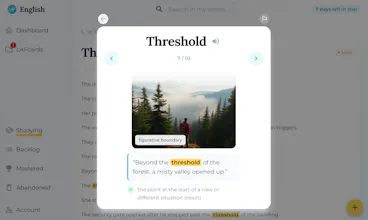
Each word arrives across ten varied real-world sentences with native pronunciation and an image. Not to teach you the word in those exact ten situations — to give you the felt sense of its range, so you can use it in the hundred situations you haven't seen yet. Spaced repetition cements the contexts; the leverage is the spread.
Built solo for B1+ learners stuck between "I finished Duolingo" and "I can actually have this conversation." English + Spanish today, Italian and German on the roadmap.
7-day free trial, no credit card. Happy to answer questions.
How do you actually decide which 100 words to show next, and can I bring in my own list from something like Anki to shape the deck?
@fatih915449 Two questions, two answers:
"Which 100 next?" — LAFwords isn't a pre-built deck; you decide the vocabulary. Words go in the way you actually meet them: something from a novel, a podcast you rewound, a conversation where the word wouldn't come. Each word arrives as a card with ten varied real-context sentences — so you feel the word's range, not one memorized pair. FSRS handles the when — bringing each one back at the moment you'd otherwise forget. So the "which" is you; the "when" is the algorithm.
"Bring in my Anki list?" — Not yet. One at a time for now. Bulk import is on the roadmap. One nuance worth flagging: an Anki deck built around word↔translation pairs is doing different work than LAFwords. LAFwords targets the words you've met but can't yet quite use in real conversation — the ten contexts building the range for the hundred you'll meet next. When bulk import ships, whatever you bring in from Anki should get auto-regenerated as full LAFcards — the ten contexts, image, and native pronunciation, built from just the word. That treatment is aimed at intermediate-to-advanced vocabulary — if your Anki list is that kind, transferring will pay off; if it's more beginner-drill material, LAFwords may not be the right place for it.
If bulk import matters to you, let me know your typical deck size and I'll bump it up the queue.
Congrats on launching, Andrey! Really like the "contexts, not translations" idea, I ended up doing the same thing back in my US days, just from reading books. You learn a word faster when you see it used in a few different real sentences than when you just see "word = other word" on a flashcard. As the Germans say, every comparison limps (they do really have this saying).
@konstantin_avksentyev Thanks Konstantin! Reading native books is honestly the gold-standard version of what LAFwords tries to compress. The app is basically an attempt to make that mechanism accessible to people who don't have unlimited reading time.
And thank you for "every comparison limps", it's going in my back pocket. Perfect Germanism.