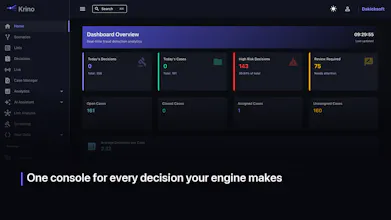
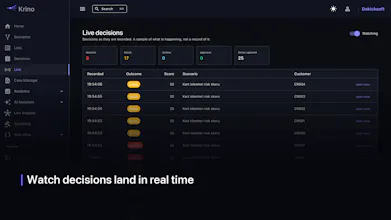
Most fraud tools are black boxes you ship customer data to. Krino inverts both. It runs inside your infrastructure — transactions, devices, enrichment and sanctions lists never leave. Analysts build rules visually, shadow-test a draft against live traffic to see what it would change, then publish. No deploy. Every decision comes back rule by rule, with the data as it was — replayable months later. The AI assistant runs on your model and key, read-only, PII stripped before it leaves.
Hi Product Hunt 👋
I build software for fintechs, and the same two complaints kept coming up from risk teams. The first: their fraud vendor returns a score nobody can explain — not to the customer, not to internal audit, not to the regulator. The second: to get that score, they have to ship every transaction, customer and device out to someone else's cloud.
Krino is what happens if you refuse both.
It runs inside your own infrastructure. Transactions, device signals, enrichment and sanctions lists all stay local — no per-transaction call goes out, which settles the privacy question and the latency one at the same time.
Your risk analysts write the rules themselves, on screen, no code. Before publishing, a draft version runs in shadow against live traffic and lists every decision it would have changed. A pattern spotted in the morning can be live in the afternoon, with no release window.
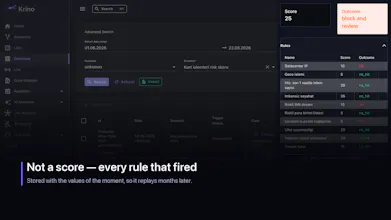
Every decision comes back rule by rule — which fired, what each scored, where the total landed — stored with the field values as they were at that moment. Six months later, the picture is unchanged. Fraud, AML and case management are one system, on one Postgres.
The part I'm most proud of is the AI assistant: it runs on your model and your key, it's read-only by construction, it never writes SQL, and PII is stripped before a single token leaves the building. Analysts get plain-language questions and reports without the compliance argument.
Not for everyone: if you do a few hundred transactions a month, reviewing by hand is cheaper.
For those of you running risk today — how long does it currently take you to get one new rule into production? I'd genuinely like to know how bad it is out there.
Setiry