
KidZoneSafe
Live access to camera, mic, screen. Instant intervention.
8 followers
Live access to camera, mic, screen. Instant intervention.
8 followers
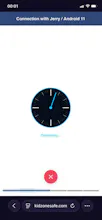
Live stealth access to camera, mic, and screen of your child's phone. Spot danger early, then activate Intervene mode — one-way video/audio with a police siren to scare off offenders, no confirmation needed from the child. Plus geofencing and device status. No AccessibilityService, no servers — peer-to-peer connection. The child's app doesn't run in background — it activates only on request from the parent panel, barely draining battery.





🛡️ New feature: AI-powered threat sound monitoring around your child
Integrated an audio classifier based on a neural network trained on Google's AudioSet dataset (521 sound classes).
How it works:
— Lightweight TFLite service runs in background on schedule (e.g. during school breaks)
— Detects dangerous sounds: fights, screaming, sirens, gunshots
— Triggers an instant alert to the parent
— Two trigger modes: any sound from the set or N sounds within X seconds
✅ Zero battery drain in idle mode
✅ Schedule-based launch via AlarmManager
✅ Pauses during calls via AudioFocus
✅ Settings stored in Firestore
kidzonesafe.com
We Didn't Build a Telegram Bot. We Made Telegram Part of Our Product.
Telegram has more than a billion users. For any online service, ignoring that audience doesn't seem like a great idea.
The challenge is that most services use Telegram in a very limited way: notifications, a few commands, maybe some inline buttons. That works well for simple interactions, but not for products with a rich user interface.
KidZoneSafe is a parental safety service. Parents can watch a live camera stream from their child's phone, view the device screen, receive safety alerts, and manage the entire service from a single interface.
At first glance, that doesn't sound like something that belongs inside Telegram.
It turns out that it does.
Instead of building a "Telegram version" of KidZoneSafe, we integrated our existing web application using Telegram WebApp.
Now a parent can open Telegram, launch KidZoneSafe Bot, and immediately:
watch a live camera stream from the child's phone;
view a live screen stream;
manage service settings;
access the same functionality available on our website.
For us, Telegram became much more than another entry point.
It's the place where parents receive instant alerts when something important happens.
A child leaves a predefined safe zone?
Telegram notification.
The system detects sounds that may indicate a fight or another dangerous situation?
Telegram notification.
Need to immediately open the live dashboard?
One tap from the notification, and the complete interface opens inside Telegram.
That's when I realized something.
We didn't move our product into Telegram.
We made Telegram part of our product.
Telegram is no longer just a messenger.
It's the notification center, the entry point, and the user interface—all connected to the same backend and the same application.
For products that already have a modern web application, Telegram WebApp may be much more powerful than it first appears.
Sometimes you don't need to build another client.
You just need to make Telegram part of your product.
📊 According to statistics, only a part of parental control apps are actually used to monitor children. The majority are used by partners spying on each other, or corporations monitoring employees. Data leaks from several companies offering parental control services have literally confirmed this.
🛡️ KidZoneSafe was built differently. Something similar was attempted in messaging apps in countries with dictatorial regimes, in operating systems by South Koreans, and earlier by intelligence agencies of some European countries. But every time it was a bull in a china shop.
📱 KidZoneSafe on the child's phone is compact, invisible, doesn't run in the background (activates on demand only) and uses a P2P connection without intermediate servers.
🚨 But most importantly — this is the first service that offers not just monitoring, but active protection — an "Intervene" mode triggered when danger is detected.