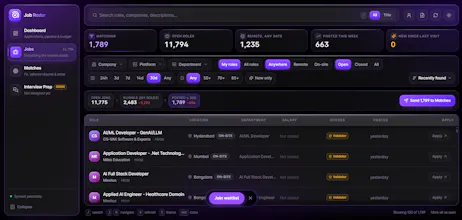
Other tools surface more jobs. Job Radar removes the ones that were never yours. One sweep, 13 remote boards, then four auditable rules: can they hire from India, is the pay real, is it your level, is it your kind of role. 11,794 → 2,500. Those get scored against your actual résumé; 15 get read properly — strengths, must-have gaps, which gap gets you rejected. Every step shows what it dropped and why. The résumé tailoring refuses to claim a stack you can't prove. You always press submit.
Hey Product Hunt 👋
I'm Ashish, a full-stack/AI engineer in India, and I built this because the
job board was working against me.
There were 11,794 open engineering roles on the boards I watch. Almost none
were mine. Half said "remote" and meant "remote if you're in the US" — and
they tell you that on line 40 of the description, after you've read the other
39. Checking fit by hand is about four minutes a posting. Tailoring a résumé
properly is closer to forty minutes. So you send five applications a week
instead of fifty, and the good ones expire while they're still open in a tab.
Job Radar does the removing. 13 remote boards plus company ATS boards, one
sweep a day, then four hard rules: can they hire from India, is the stated pay
real, is it my level, is it my kind of role. ~2,500 survive. Those get scored
against my actual résumé — not a keyword list, the evidence in it — 68 make a
shortlist, and 15 get read properly. What comes back isn't a score, it's a
verdict: what I'm strong on, what's missing, and which of those gaps they'll
actually reject me for.
Two things I care about more than the ranking:
**Nothing is hidden, only filtered.** Every stage shows what it dropped and
why, and any posting will tell you which rule rejected it. You can argue with
it, and change the rule.
**It won't lie on my résumé.** Ask it to add Kubernetes and AWS and it refuses,
quoting the line in my own profile that says I don't have them. A résumé that
invents experience is worse than no résumé — it's a lie with my name on it, and
if it reads well I won't catch it at review time.
And it never submits anything. Autofill is next, and it's review-before-submit
by design. Pressing send is always me.
The demo is live with real postings and my real résumé (the phone number is the
one redaction). Browsing, filters, funnels, the tailored résumé, the diff
against my base CV and the fact-check refusal are all real. The four calls that
would cost a model are stood in for, and the demo says so and names what each
would cost — I'd rather show you the seams than fake a spend.
It's a personal tool today, self-hosted and single-user. There's a waitlist in
the demo if you'd want one pointed at your own résumé.
Four things I'd genuinely like to hear:
1. What would make you trust something like this with your résumé?
2. If you job hunt from outside the US — how much of your time goes to postings
that were never open to you in the first place?
3. Does the core idea actually hold up for you? The bet here is that the useful
move is *removing* jobs, not surfacing more of them. Tell me if that's wrong,
or if you'd want it to work some other way entirely.
4. And bluntly: what would you rate it out of 10 — and what's the one thing
standing between that number and a 10? The second half is the part I'll
actually build.