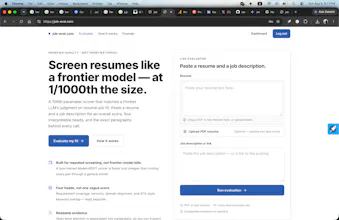
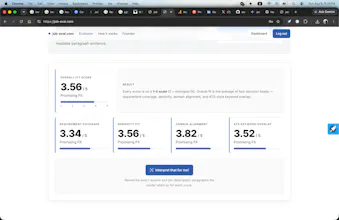
Screen resumes against a job in seconds. Paste a resume and a job description (or a link) and a specialized 156M-parameter ModernBERT model — not an expensive frontier LLM — returns an overall 1–5 fit score plus four explainable heads: requirement coverage, seniority, domain alignment, and ATS-style keyword overlap. Click to reveal the exact resume and job-post paragraphs behind each score. Fast, cheap, private, and explainable.
No reviews yetBe the first to leave a review for job-eval
Maker
📌
A new generation of AI job-application tools has made the hunt dramatically easier. Projects like career-ops (https://github.com/santifer/care...) — a highly respected, widely used open-source toolkit — automate the whole pipeline: parsing postings, tailoring materials, and scoring how well a candidate fits each role. They're genuinely good.
But they share one expensive assumption: every resume-to-job evaluation gets routed through a frontier LLM. That's the costly part. Frontier-model API calls add up fast — and in these tools you're not scoring one job, you're scoring dozens or hundreds, over and over, for every user. The fit-evaluation step quietly becomes the biggest line on the bill, and for a task that repeats constantly, that cost is hard to justify.
Here's the insight: scoring resume-to-job fit is a narrow, repeatable problem — it doesn't need a general-purpose giant. So instead of renting a frontier model for it, we trained a small model to do exactly this one job.
job-eval.com runs on a specialized ~156M-parameter ModernBERT scorer, fine-tuned specifically for resume-to-job fit — over a thousand times smaller than a frontier LLM, fast enough to run on a plain CPU, and private enough to keep candidate data on your own hardware. It's designed to drop in and replace the evaluation step in workflows like career-ops, keeping the quality while removing the frontier-model cost.
And it holds up. In an independent benchmark, a frontier model (Claude Code) graded a set of resume-to-job pairs by hand, then had our small model grade the same ones — and it agreed almost every time. Strong agreement (quadratic-weighted kappa ≈ 0.83, ~0.90 score correlation, 99% of scores within a single point), and it never once ranked a strong candidate below a mismatch. Similar results, a fraction of the cost.
Just as important, it isn't a black box. Every score breaks into four explainable heads — requirement coverage, seniority fit, domain alignment, and ATS-style keyword overlap — each on a 1–5 scale. And with one click, "interpret that for me" surfaces the exact resume and job-description paragraphs the model actually relied on, drawn from its own attention. You don't just get a number; you get the evidence behind it, so you can trust it and defend it to a hiring manager.
The pitch, in one line: you don't need to pay frontier-model prices to screen resumes — a small, task-trained, explainable model does the evaluation just as well, for a rounding error on the cost.