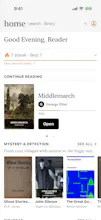
A reading environment that trains deep focus: the great books, immersive reading modes, and an AI that challenges you to think — not one that thinks for you.
No reviews yetBe the first to leave a review for IO reader
Maker
📌
Hi Product Hunt — Min here, I built IO reader.
It started as a personal problem: I'd lost the ability to read a hard book without my attention leaking out every paragraph. Every "AI + reading" product I tried made it worse — they competed on reading the book for me. Summaries, key takeaways, "read less."
So I built the opposite. IO reader pairs the public-domain classics — Project Gutenberg and the hand-edited Standard Ebooks editions (and you can import your own DRM-free EPUB ebook) — with 12 AI personas that are built around one rule: none of them may summarize the book for you. The Critical Thinker surfaces the assumption you were about to swallow. The Questioner runs Socratic method on the page you're stuck on. The Interpreter rebuilds a hard passage in the shape of things you already understand, tuned to a short reading profile you set.
The interface makes the same bet: a sentence-at-a-time reading mode, square editorial geometry, print-grade typography, and no engagement mechanics — nothing that scrolls for the sake of scrolling.
It's on the App Store now. The full library and every reading mode are included; heavier AI is unlocked with an IO+ subscription.
I'd genuinely love your hardest questions about the design — especially the "why not just summarize" objection, which I have opinions about. — Min
Report
How does the AI actually challenge you without just giving answers away — does it ask Socratic questions or flag passages you might be glossing over?
Report
Maker
@sedanurnnjz Both, depending on which persona you tap. The Questioner runs Socratic method — it answers your question with the question underneath it. The Critical Thinker is the flagging one: it names the assumption in the passage you were about to swallow and hands it back to you. The one rule shared by all 12 personas is that none of them may give you the conclusion — no summaries, no "what this passage means." I walked through a concrete Dostoevsky exchange in my reply to Erdem above if you want to see the actual shape of it. I suggest you to download the app and give it a try. 60 AI responses are free!
Report
Curious how the AI actually pushes back without just summarizing or giving away the answer. What does a typical challenge look like while reading something dense like Kant or Dostoevsky?
Report
Maker
@erdemzdzmxx3 Good question — easiest to just show one. Here's the passage in Crime and Punishment where Raskolnikov lays out his "extraordinary man" theory (Part 3, Ch. 5):
"...an extraordinary man has the right... an inner right to decide in his own conscience to overstep certain obstacles, and only in case it is essential for the practical fulfilment of his idea (sometimes, perhaps, of benefit to the whole of humanity)."
A summary product tells you: "Raskolnikov argues great men may transgress moral law for humanity's benefit."
True — and now you've skipped the most argued-about pages in the book.
Tap that paragraph with the Critical Thinker and this is what comes back — actual output, unedited:
"Raskolnikov's elaborate justification for 'extraordinary' men to transgress the law hinges on the retrospective validation of their actions by history, implying that success alone legitimizes their methods. This perspective conveniently sidesteps the immediate, tangible suffering inflicted by such transgressions, reducing victims to mere obstacles in the path of progress. The argument also fails to provide a clear, objective metric for identifying these 'extraordinary' individuals before their actions are judged by history, creating a dangerous loophole where anyone could claim this 'inner right' to violence. How does one distinguish a true 'man of the future' from a mere psychopath before the historical verdict is rendered?"
No verdict on the book, no summary — an objection you have to take back into the text to answer. (Raskolnikov's examples are Newton, Kepler, Lycurgus, Napoleon — all men history already vindicated; the AI is pointing out he needs the label before the act.) That's the design test for all 12 personas: if you can respond to the AI without rereading the passage, the persona failed.
Kant gets the same treatment. The Groundwork's shopkeeper passage is a favorite, because the honest-from-prudence vs. honest-from-duty distinction is asserted more than argued there, and the persona will point that out and make you defend it.
One honest caveat: it's a language model, so quality tracks the passage. On argument-dense text like this it's consistently sharp; on pure plot pages it has less to bite into.
Report
the immersive reading modes look beautifully restrained, like they actually thought about how a page should feel rather than just piling on features
Report
Maker
@elifsuowp1 That's the design contract in one line — the question for every screen was what a page needs, not what an app usually has. Square geometry, no shadows, print typography, nothing that moves unless you moved it. Glad it reads that way.
Report
I like that you're treating AI as something that challenges the reader instead of replacing the act of thinking.
As models get better at generating answers, I think products that strengthen human reasoning become more valuable than products that simply produce more text.
Helping people think better feels like a durable direction.
Report
Maker
@aryan787544 Happy to meet someone who is sharing the idea about value of AI and how to adopt it to the product. :) Please try to use IO reader and share your feedback. I think there will be areas to improve further and your feedback will be valuable.
One thing I'll be paying close attention to isn't just whether the AI helps people think more deeply, but whether it changes how they approach reading after they close the app. That's a much harder outcome to create, but it also feels like the difference between a useful AI feature and a lasting reading habit.
I'll spend some time with IO Reader and share my thoughts.
Genuinely impressed by how the AI nudges you to wrestle with ideas instead of spitting out answers. The reading mode is clean and keeps me from drifting off.
Report
Maker
@tolgakaraat"The reading mode is clean and keeps me from drifting off." is exactly what I wanted to achieve through this app. Thanks a lot for your valuable comment and please let me know if there is anything to further improve.
How does the AI actually challenge you without just giving answers away — does it ask Socratic questions or flag passages you might be glossing over?
@sedanurnnjz Both, depending on which persona you tap. The Questioner runs Socratic method — it answers your question with the question underneath it. The Critical Thinker is the flagging one: it names the assumption in the passage you were about to swallow and hands it back to you. The one rule shared by all 12 personas is that none of them may give you the conclusion — no summaries, no "what this passage means." I walked through a concrete Dostoevsky exchange in my reply to Erdem above if you want to see the actual shape of it. I suggest you to download the app and give it a try. 60 AI responses are free!
Curious how the AI actually pushes back without just summarizing or giving away the answer. What does a typical challenge look like while reading something dense like Kant or Dostoevsky?
@erdemzdzmxx3 Good question — easiest to just show one. Here's the passage in Crime and Punishment where Raskolnikov lays out his "extraordinary man" theory (Part 3, Ch. 5):
"...an extraordinary man has the right... an inner right to decide in his own conscience to overstep certain obstacles, and only in case it is essential for the practical fulfilment of his idea (sometimes, perhaps, of benefit to the whole of humanity)."
A summary product tells you: "Raskolnikov argues great men may transgress moral law for humanity's benefit."
True — and now you've skipped the most argued-about pages in the book.
Tap that paragraph with the Critical Thinker and this is what comes back — actual output, unedited:
"Raskolnikov's elaborate justification for 'extraordinary' men to transgress the law hinges on the retrospective validation of their actions by history, implying that success alone legitimizes their methods. This perspective conveniently sidesteps the immediate, tangible suffering inflicted by such transgressions, reducing victims to mere obstacles in the path of progress. The argument also fails to provide a clear, objective metric for identifying these 'extraordinary' individuals before their actions are judged by history, creating a dangerous loophole where anyone could claim this 'inner right' to violence. How does one distinguish a true 'man of the future' from a mere psychopath before the historical verdict is rendered?"
No verdict on the book, no summary — an objection you have to take back into the text to answer. (Raskolnikov's examples are Newton, Kepler, Lycurgus, Napoleon — all men history already vindicated; the AI is pointing out he needs the label before the act.) That's the design test for all 12 personas: if you can respond to the AI without rereading the passage, the persona failed.
Kant gets the same treatment. The Groundwork's shopkeeper passage is a favorite, because the honest-from-prudence vs. honest-from-duty distinction is asserted more than argued there, and the persona will point that out and make you defend it.
One honest caveat: it's a language model, so quality tracks the passage. On argument-dense text like this it's consistently sharp; on pure plot pages it has less to bite into.
the immersive reading modes look beautifully restrained, like they actually thought about how a page should feel rather than just piling on features
@elifsuowp1 That's the design contract in one line — the question for every screen was what a page needs, not what an app usually has. Square geometry, no shadows, print typography, nothing that moves unless you moved it. Glad it reads that way.
I like that you're treating AI as something that challenges the reader instead of replacing the act of thinking.
As models get better at generating answers, I think products that strengthen human reasoning become more valuable than products that simply produce more text.
Helping people think better feels like a durable direction.
@aryan787544 Happy to meet someone who is sharing the idea about value of AI and how to adopt it to the product. :) Please try to use IO reader and share your feedback. I think there will be areas to improve further and your feedback will be valuable.
@min_byun I'd be happy to.
One thing I'll be paying close attention to isn't just whether the AI helps people think more deeply, but whether it changes how they approach reading after they close the app. That's a much harder outcome to create, but it also feels like the difference between a useful AI feature and a lasting reading habit.
I'll spend some time with IO Reader and share my thoughts.
@aryan787544 That sounds great! Please rate and write review in Apple App Store https://apps.apple.com/us/app/io-reader-read-deeper-with-ai/id6767890380 . That will be greatly helpful.
Genuinely impressed by how the AI nudges you to wrestle with ideas instead of spitting out answers. The reading mode is clean and keeps me from drifting off.
@tolgakaraat "The reading mode is clean and keeps me from drifting off." is exactly what I wanted to achieve through this app. Thanks a lot for your valuable comment and please let me know if there is anything to further improve.