
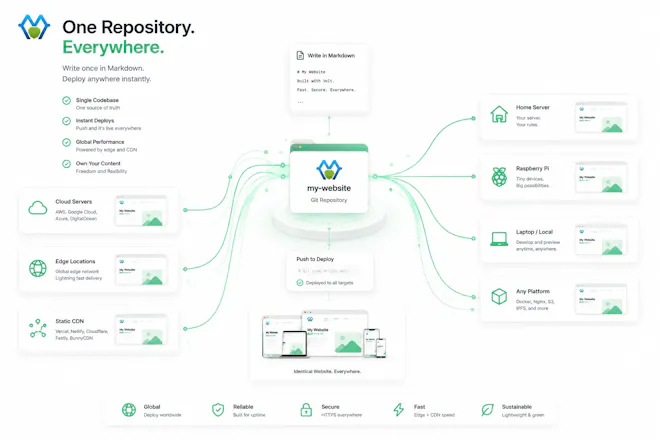
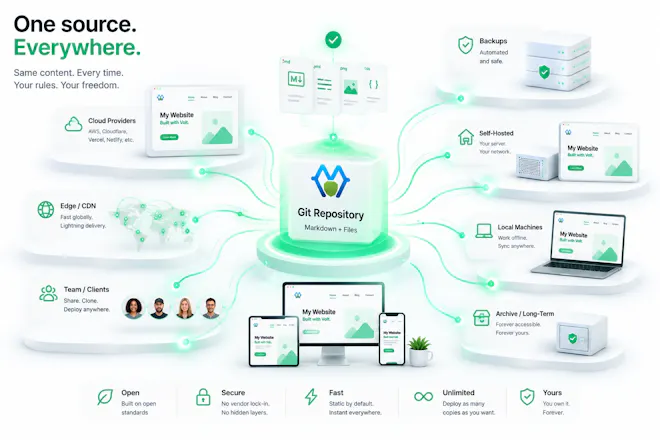
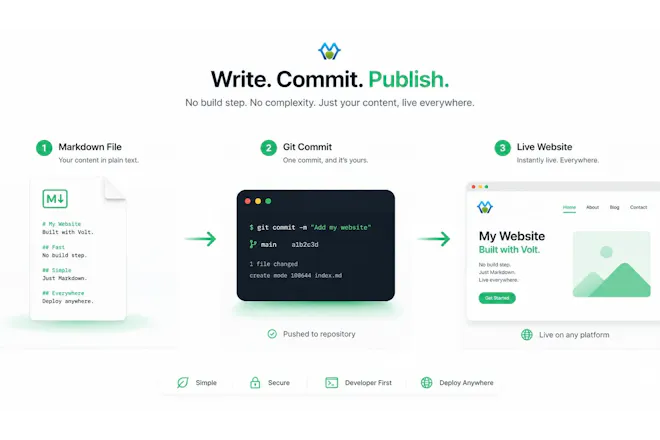
Volt gives you WordPress's ease without its stack. Your whole site is plain Markdown files in Git -- no database, no build step, no lock-in. Write or use the visual editor, hit save, and it's live as fast static pages. One command migrates a live WordPress site: pages, posts, media, menus, and URLs kept. Batteries included: free HTTPS, sitemaps, image CDN, and contact forms with invisible spam protection (no reCAPTCHA, no third parties). Export anytime, self-host anywhere, or host from $0.





Free Options
Launch Team

Dropbox SignSimple, secure eSignatures for the way your team works.
Promoted
WordPress has always felt heavy for what I actually need, so the Git-based Markdown setup here is genuinely appealing. Migrating a live WP site in one command sounds almost too good to be true, but I like that I could just export everything and walk away if it stops working.
@ecringeen193f Thanks Ecrin -- and keep the healthy skepticism, it's warranted. Straight about the "too good to be true" part: it nails the boring-but-hard stuff -- content, exact URLs, media, your theme's design intent -- in one command. Where it's careful rather than magic is custom territory: bespoke plugins, custom post types, ACF fields. Those get flagged and surfaced, not silently converted -- so you always see what needs a human hand, instead of trusting a black box.
But the thing that makes your instinct exactly right: "walk away" isn't a promise, it's just the architecture. What you get out is plain .md files and a .env in a git repo -- the migration tool isn't in the loop afterward. No runtime dependency on it, no service to keep paying, no format to reverse-engineer. If it vanished tomorrow, your site keeps running, because it's just files. Even a partial migration leaves you with something you own, not a trapped mess.
That's the real answer to "what if it stops working" -- you already have everything, in a format that predates all of us and will outlive it.
Finally someone said it. WordPress made sense in 2008 but keeping a whole PHP stack alive for a simple blog has felt absurd for years. The one command WordPress migration is the part that actually sold me, because porting years of content is usually where these tools fall apart.
@golgelisem16238 Thanks Semiha -- you put your finger on it. A blog is text. Publishing words shouldn't mean running and securing a dynamic web application: a database, a PHP runtime, a login panel, thirty plugins, and a patch treadmill so nobody roots your box while you sleep. That stack made sense when the alternative was hand-editing HTML. Today it's a lot of moving parts to serve some paragraphs.
And you're right that content porting is where these tools go to die. The DX demos are easy; the honest test is "can I get ten years of posts out -- with my URLs, my images, my structure intact -- or am I trapped?" Most static-site tools wave at an importer and let it mangle the details. Making migration the first-class feature instead of an afterthought is the whole bet -- because a beautiful editing experience you can't actually escape to isn't freedom, it's a nicer cage.
Glad that's the part that sold you. That was exactly the intent.
Migrated a small WordPress blog over and everything came across clean, including the old URL structure. The fact that the whole site is just Markdown in Git feels like such a relief after years of database headaches.
the migration path that preserves menus and URLs is such an underrated move, makes switching from WordPress feel almost boring in the best way.