
GitWicket
Your GitHub profile, rated like a cricket player card
11 followers
Your GitHub profile, rated like a cricket player card
11 followers
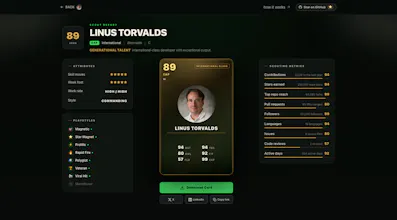
GitWicket turns your GitHub activity into an ICC-style cricket player card. Get an overall rating (50–99), a role (Batter, Bowler, All-Rounder, Wicket-Keeper, or Captain), six attribute scores, and a scouting report — generated from your real stats. No sign-up. Just your username. ✓ Download as PNG ✓ Share to X, LinkedIn, WhatsApp ✓ Next.js 15 + TypeScript ✓ Open source For devs who grew up on cricket video games, or curious what their commits say about them.



How does it actually decide the role and overall rating from GitHub activity, like is it looking at commit messages, languages used, or something else entirely?
@efeerkolpgav It's entirely stat-based, not commit-message parsing no NLP on your messages. Six attributes get pulled from six different GitHub signals:
- Batting: contributions, commits, public repos, stars
- Bowling: pull requests, issues, forks
- Fielding: code reviews, repos contributed to, issues
- Technique: languages used, repo diversity, documentation ratio, stars
- Fitness: active days, streak, recent activity, account age
- Experience: account age, followers, contributions
Each is normalized logarithmically against elite-level benchmarks (so raw numbers don't just linearly dominate), then the overall rating is a weighted combo of all six. Role gets assigned based on which attributes are strongest relative to the others.
@efeerkolpgav There's also a "How it Works" breakdown right on the site if you
want the full picture at a glance.
How does it decide between Batter and Bowler when someone's commits are pretty evenly split across the year?
@cingis72428 Good question — it's not about commit timing, it's about the shape of the stats. BWL is weighted mostly on PRs and issue-solving (45%/35%), while BAT leans on raw contributions and commit volume (40%/30%). So if someone's split is "evenly timed" but their PR count is significantly higher relative to their commits, they'll skew Bowler. If it's genuinely balanced across both attribute values (not just timing), the role logic checks whether their overall rating spread is tight (≤12 points across all six attributes) — in that case they get tagged All-Rounder instead of forcing a Bat/Bowl split.
the role assignment logic is genuinely clever, especially the Captain edge case based on repo ownership and contribution share. love seeing real commit data feeding into the scouting report instead of placeholder flavor text.
@yunustrkseddvj Really appreciate that the Captain logic was actually one of the trickier ones to get right. It's gated on Experience ≥94, account age ≥8 years, and followers ≥1500, so it's meant to reward long-standing, community-recognized profiles rather than just raw output. Glad the "real data, no flavor text" part came through that was the whole point, wanted every number on the card to be traceable back to an actual GitHub signal.
The no-signup-just-username flow is a really nice touch, gets you to the fun part in seconds. Love that the role assignment feels like it actually maps to commit patterns rather than being random.
@nevinyurdakan Thanks, Nevin! That was exactly the goal — wanted it to feel instant and fun, not like filling out a form. Glad the role logic landed too, that part took a few iterations to get right.