Launching today

GitVelocity
Every merged change scored. See how far AI has taken you
5 followers
Every merged change scored. See how far AI has taken you
5 followers
The AI engineering benchmark. GitVelocity scores every merged change for how much engineering it took. 📈 See your multiplier: how far AI has taken your team 🏆 See where you stand among 4,000+ engineers 🧮 Complexity, not volume: six public dimensions, no hidden weights 🔒 We never store your source code ⌨️ Also in your terminal: CLI, MCP server and public API 🆓 Free: bring your own model key




Hi Product Hunt! I am one of the makers of GitVelocity, the AI engineering benchmark. It scores every merged change for how much engineering it took, so you can see how far AI has taken your team. We've been building it at Headline for the past year and we're finally ready to share.
Why we built this 📖
Six months into our team using AI heavily, our CTO asked the question every leader is asking right now: "are we actually shipping more?" The honest answer was: we have no idea. The token bill told us how much AI we were buying, not what came out the other end. PR count and lines of code measure how much stuff moved, and an agent inflates both in seconds. Story points are guesses made before the work starts. DORA metrics describe how work moves through the pipeline, not how much engineering got built.
Meanwhile, agents were changing the shape of our work, and volume stopped meaning anything. A config key rename across 34 files and a concurrent batch processor in 11 files are not the same engineering. None of our tools could tell them apart.
What GitVelocity does 🔍
Every merged change is read by a frontier model and scored on six dimensions: scope (0–20), architecture (0–20), implementation (0–20), risk (0–20), quality (0–15), and performance & security (0–5). Those add up to a base score out of 100, which a published size multiplier then scales. There are no hidden weights, so you can always see where the points came from. On that rubric the rename scores 23 and the batch processor scores 68.
Months of those scores make an engineer's multiplier: how complex the work they ship is now, against their own history from before the agents. You get it for each engineer and for the whole org, and you can see where you stand among the 4,000+ engineers in the benchmark. So far GitVelocity has scored 300k+ merged changes across 7,000+ repositories.
What you get 📦
Free. Bring your own model key. Anthropic is the default (Claude Sonnet 5.5), and OpenAI, OpenRouter and Claude on AWS are supported too. Your provider bills you directly, usually a few cents per change. We charge nothing.
We never store source code. The diff goes to the model to be scored and is then deleted. What we keep is the score, the six sub-scores and a short written rationale.
Work, not workers. GitVelocity scores merged work the team can already see. No keystrokes, no hours, no screens. Every engineer you invite sees their own scores and the rubric.
Check our working. The six dimensions, the size multiplier tiers and the model benchmark are all public, with accuracy, cost and run-to-run stability for every model we tested.
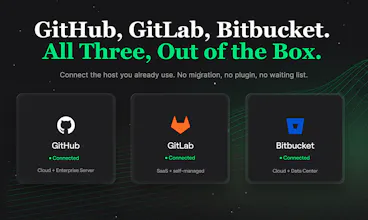
Works with GitHub, GitLab and Bitbucket, in every language.
Also in your terminal. There is a CLI, an MCP server so your agent can read scores directly, and a public REST API with personal access tokens.
Try it without signing up at gitvelocity.dev/demo.
For the terminal people ⌨️
What I'd love feedback on 💬
What's the scoring dimension you wish existed?
What number would you actual?
And what would make you stop trusting an AI-generated score? Those answers help us most.
Thanks for taking a look! 🎉