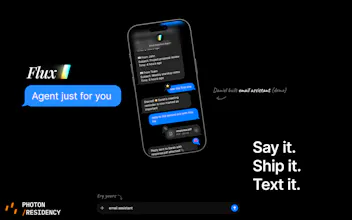
AI doesn’t have an intelligence problem - it has an interface problem. Flux is the first platform for building personalized conversational agents that live inside messaging platforms like iMessage and WhatsApp. By meeting users where they already communicate, Flux enables agents to feel less like software and more like people - trusted friends, tutors, or assistants. The future of AI isn’t another app. It’s agents that interact with humans on an emotional level.
Hey everyone - Daniel here, one of the founders.
We started Flux after realizing something kind of obvious in hindsight: AI agents are already smart enough. The real bottleneck is how people actually interact with them.
Most agents live behind apps and dashboards that don’t feel natural. We wanted to see what happens when agents live where real conversations already happen - iMessage, WhatsApp, group chats - and speak the same messy, human language we do.
Flux is our attempt at that.
Not another app, but a way to build agents that can actually feel like a friend, tutor, or someone you trust.
Would love to hear what resonates (or doesn’t). We’re very early and learning fast.
Report
@daniel_tian3 really like the idea and the philosophy behind Flux. I haven’t tested it yet because a lot of the conversations I deal with fall into sensitive categories, but I wanted to suggest a few features that would make this especially usable for people like me:
Full user control over agent involvement Let users explicitly choose when the AI can help with a simple on/off or “only respond when mentioned” mode. That control alone would build a lot of trust.
Clear data transparency Tell users exactly where their data is stored, whether it’s encrypted, and whether anything is logged long-term or just processed temporarily. Even a simple explanation goes a long way.
Strong safety boundaries by default The agent should clearly refuse to assist with illegal or harmful requests (e.g., drugs, violence, fraud). I actually work in security and would be happy to help think through this part if it’s useful.
Messaging-native agents live in a very high-trust space, so strong defaults around user control, data handling, and safety boundaries really matter. If you ever want an adversarial / red-team style look at agent behavior in real chat environments, happy to help.
@daniel_tian3 Daniel — this framing actually hits the real problem.
Most AI agents are capable, but they’re trapped behind interfaces that force humans to adapt to software — instead of the other way around. Putting agents where conversations already happen (iMessage, WhatsApp, group chats) feels like the right abstraction layer.
One thing that stood out to me: products like Flux don’t need louder marketing — they need the right people to experience it in-context. When users see an agent behave like a friend or assistant inside real conversations, the value clicks instantly.
I work with early AI products on creator-led discovery — not promos, but controlled tests where builders, operators, and creators use the product naturally and share that experience with their audience. It’s been a clean way to validate messaging and distribution early, especially for interface-first tools like this.
If you’re open, I’d be curious to explore a small discovery test around Flux with creators who already live inside messaging workflows. Even just to learn what resonates (or doesn’t) before you scale.
Either way, this is a thoughtful direction. Looking forward to seeing how Flux evolves.
— Aditya
Founder, SHYNX Media
Report
I really like Flux’s idea of integrating AI agents into iMessage, but how do you protect user privacy?
Report
My number doesn't seem to be working! Please help, its a american Imessage Number.
@ohansemmanuel It now works for non-us numbers! That was a frontend issue I fixed this morning.
Report
I have seen AI chatbots that integrate with Slack, MS Teams, Whatsapp, but not yet iMessage. I think it's a brillant idea, and very user friendly. I'm a bit jealous as I'm building an AI chatbot app, as well, but did not have your idea. Chapeau!
As the designer on Flux, I spent a lot of time thinking less about what agents can do and more about how they should show up.
Chat is an emotionally loaded space. An agent there can’t feel like a tool that interrupts, it has to earn its place through timing, tone, and restraint. A big part of the design work was figuring out when an agent should stay silent.
Flux is our first attempt at treating agents not as features, but as social participants. Still very early, but excited to learn from how people actually use it.
Report
Wouldn't recommend this tool, inputing the phone number on the website and nothing happens, if the country or the number is not supported I would expect at least some kind of feedback in the UI 😞
Spectrum
@daniel_tian3 really like the idea and the philosophy behind Flux. I haven’t tested it yet because a lot of the conversations I deal with fall into sensitive categories, but I wanted to suggest a few features that would make this especially usable for people like me:
Full user control over agent involvement
Let users explicitly choose when the AI can help with a simple on/off or “only respond when mentioned” mode. That control alone would build a lot of trust.
Clear data transparency
Tell users exactly where their data is stored, whether it’s encrypted, and whether anything is logged long-term or just processed temporarily. Even a simple explanation goes a long way.
Strong safety boundaries by default
The agent should clearly refuse to assist with illegal or harmful requests (e.g., drugs, violence, fraud). I actually work in security and would be happy to help think through this part if it’s useful.
Spectrum
@sujal_meghwal This is exactly the bar we want to meet. User control, clear data handling, and strong safety defaults are non-negotiable for us.
@daniel_tian3 That’s good to hear.
Messaging-native agents live in a very high-trust space, so strong defaults around user control, data handling, and safety boundaries really matter. If you ever want an adversarial / red-team style look at agent behavior in real chat environments, happy to help.
Chert
@daniel_tian3 @sujal_meghwal Thank you for your feedback! Would make sure the address the concerns.
Spectrum
@bekjon_ibragimov will also be supported in our coming release!
Chert
@daniel_tian3 @bekjon_ibragimov next release!
@daniel_tian3 can I use it to build an ai friend that can proactively text me every single hour and checking on me in iMessage?
Spectrum
@linya_peng1 yes ofc! give this a try
Chert
@daniel_tian3 @linya_peng1 Yes, it will work! Please try
I really like Flux’s idea of integrating AI agents into iMessage, but how do you protect user privacy?
My number doesn't seem to be working! Please help, its a american Imessage Number.
Coldtea.ai
Interesting take. Would love to take it for a spin once out of beta. Doesn't seem to accept non US numbers
Flux
@ohansemmanuel It now works for non-us numbers! That was a frontend issue I fixed this morning.
I have seen AI chatbots that integrate with Slack, MS Teams, Whatsapp, but not yet iMessage. I think it's a brillant idea, and very user friendly. I'm a bit jealous as I'm building an AI chatbot app, as well, but did not have your idea. Chapeau!
Spectrum
@mitja_martini Thank you! We will have a unified connection layer to all the messaging apps soon!
Chert
@mitja_martini Thank you for your feedback!
Flux
As the designer on Flux, I spent a lot of time thinking less about what agents can do and more about how they should show up.
Chat is an emotionally loaded space. An agent there can’t feel like a tool that interrupts, it has to earn its place through timing, tone, and restraint. A big part of the design work was figuring out when an agent should stay silent.
Flux is our first attempt at treating agents not as features, but as social participants. Still very early, but excited to learn from how people actually use it.
Wouldn't recommend this tool, inputing the phone number on the website and nothing happens, if the country or the number is not supported I would expect at least some kind of feedback in the UI 😞