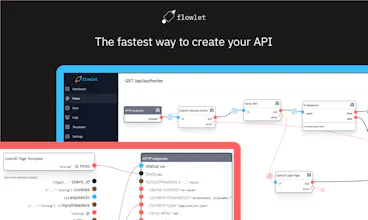
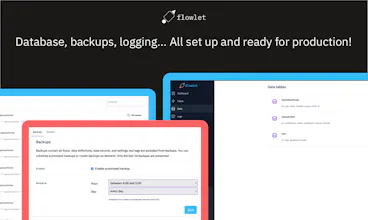
Get your next API production ready in minutes. Drag & drop visual flows combined with low-code for maximum flexibility. Directly test in the cloud and minimise the effort to launch your next API project.

No reviews yetBe the first to leave a review for Flowlet
This looks very interesting! Do you still offer your $5 deal? Flowlet was in Product Hunt's daily email today, so I assume more people would be interested.
@akiarostami Hi Ahmad, thanks!
Yes, we extend the deal until Friday the 9th.
Report
Congratulations for your launch.
So far, as for a similar solution, I've been using Pipedream. Could you explain how is your product different from that?
Thanks!
@invalidusername Thank you!
Pipedream and Flowlet have a lot in common, but there are many differences.
Pipedream is focused on webhooks, although it can do more nowadays. Incoming requests are handled by a sequence of actions that always run one after another (pipeline). You will always use scripts to make data changes and handle logic.
The primary focus for Flowlet is to provide a (REST) API. Instead of webhooks, you define HTTP endpoints. Each endpoint listens to an HTTP method and path. Flowlet handles input validation, authentication (OAuth2 and Basic Auth), and CORS headers. Instead of pipelines, you use flows to define the actions. Flows can contain if-statements, loops, and error paths, which do not exist in pipelines. Furthermore, you can handle many of the data transitions in the mapping between these blocks, so you do not always have to write a script for that.
Building a REST API is more challenging in Pipedream because you have to handle the routing, validation, and authentication yourself. More about CORS headers; Pipedream does return them but will always allow them from all domains. That may lead to security issues when used for REST APIs with cookie-based authentication.
Both Flowlet and Pipedream come with internal storage. Pipedream's datastore is a key-value store. Its values are in JSON (untyped). The data storage in Flowlet contains tabular data (tables) where each row is typed. Both services provide access from both actions/blocks and in scripts. An example in Pipedream (from their docs):
export default defineComponent({
props: {
customers: { type: "data_store" },
orders: { type: "data_store" }
},
async run({ steps, $ }) {
// Retrieve the customer from our customer store
const customer = await this.customer.get(steps.trigger.event.customer_id);
// Retrieve the order from our order data store
const order = await this.orders.get(steps.trigger.event.order_id);
},
})
You have to define the props before you can access the data store. It uses TypeScript under the hood, but the "this" variable is not typed; hence, the customer and order variables are also untyped.
A similar example in Flowlet:
export async function script1({customerId, orderId}: {
customerId: string;
orderId: string;
}): Promise<{
customerName: string;
orderStatus: string;
}> {
// Read customer data.
const customer = await db.readCustomer(customerId);
// Read order data.
const order = await db.readOrder(customerId);
// Return what we need.
return {
customerName: customer.name,
orderStatus: order.status
};
}
The function definition is fully typed. You should not be scared if you are unfamiliar with TypeScript, as describing the input and output for custom functions is all you need TypeScript for. The advantage of these typed functions is that you can use the input and output properties in the mapping. Overall, you need to write less code in Flowlet.
Scripts in Flowlet always use Node 18. Pipedream lets you choose between Node 14, Python, Go, and Bash.
Standard integrations
Pipedream ships with a few standard integrations, for example, Google Sheets. There are currently no default blocks for them in Flowlet (although we will add them over time). However, Flowlet focuses on the underlying techniques and makes it easy to call an HTTP API, even when requiring OAuth2 authentication. So, the effort to connect to APIs that lack out-of-the-box support is less with Flowlet.
Deploy step
Changes in flows in Flowlet are saved automatically and are immediately active. We tend to minimize the plan-build-test loop to increase developer efficiency (and you in the flow ;-). Pipedream requires you to press the deploy button and wait before changes are active. You don't have to wait long, though, but still longer.
Backups
Flowlet allows you to create and restore backups. These backups include your flows and data tables. I haven't seen this in Pipedream.
Logging
Pipedream stores the last 100 log entries (per source). Flowlet reserves 10MB of log data (per workspace), which normally results in 5 to 10 thousand log entries on which full text search is available.
Report
@mauritsl thanks a lot for your thorough reply! I will take the time to inspect the details you listed asap, from a quick glimpse it seems a lot of good stuff :)
Report
Congrats! Low-code products make our work easier. API with low code, excellent idea and you make it come true.🚀
Very solid idea. Anything to make the debugging process smoother is a must-try. The use of Typeform is also a great idea. Happy to see this product come to life. Congrats on your launch!
@michael_lachar Glad you like it Michael! Thanks!
Flowlet can debug flows, which lets you inspect the input and output per block. Furthermore, you can save incoming requests to the log and replay them later 😀
Report
There's this implication that "low code" is only for non-engineers - Flowlet proves it can be an incredible time saver for them as well.
@jamesyto Thanks, James!
Many no-code tools are presented as tools suitable for 'citizen developers', but even for those tools, many (if not most) of the builders have programming experience.
We're not aiming for citizen developers. We want to make the development experience more efficient. I'm pleased you see that too!
Report
This looks so great - being a maker these days is so much about your ability to connect apps and workflows. I'm looking forward to passing this on to our development team!
Flowlet
Flowlet
Flowlet
Flowlet
Brew Money | Take control of your crypto
Flowlet
Flowlet
Flowlet
Flowlet