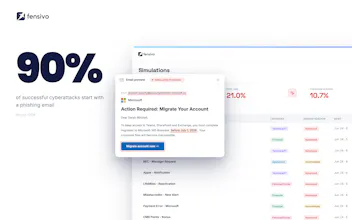
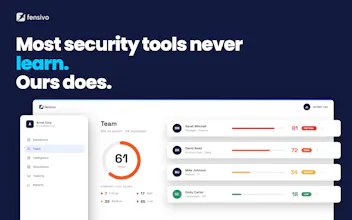
Most security tools run the same campaign for everyone and never improve. Fensivo learns. Every leaked credential, every simulation result, every slip feeds a per-person risk model that gets sharper over time, so each attack we send is better matched to who is actually vulnerable and why. It monitors the dark web, runs personalized phishing simulations, and trains people the moment they slip. Connects to Google Workspace or Microsoft 365 over OAuth, live in a day.
Hey Product Hunt! Jose here, founder of Fensivo. 👋
Many companies treat security training as a box to check: one campaign a quarter, a course nobody finishes, a report that proves activity but not safety. Meanwhile attackers got personal, patient, and relentless. Now they'v built CRMs and enriched data rooms for their preys, and the defense never improved, it just resets every quarter.
So we built the opposite: a human risk platform that learns from every signal. Each leaked credential we find on the dark web, each simulation someone passes or fails, each moment they slip, all of it feeds a per-person risk model. The longer it runs, the better it predicts who is vulnerable, to which pretext, and when, so the next simulated attack is sharper than the last. We train people the moment they fall and retest them later, but the real engine is the continuous learning underneath, not any single trick.
One thing we refuse to fake: finishing a course does not predict whether someone resists a real attack, so we built a model that is not selling completion rates and have started proving behavior change.
We are early and built natively for Latin American companies, a market most tools reach only as a translation.
I would love your honest take on two things:
does "a system that learns per person" land as real, or sound like a buzzword?
And if you have sold to security buyers, did you lead with the differentiator or with the pain? I am here all day. Fire away. 🚀
Report
How does the per-person risk model handle employees who switch teams or roles often, does it retrain automatically or do you need to manually flag the change?
Report
Maker
@gnesrpq Good question. Since we connect to your Google Workspace or Microsoft 365 directory over OAuth, as long as that directory is kept up to date we just read the change from there, so a move to a new team or role flows in on its own, no manual step. If the directory isn't kept updated, then yes, that change would need to be flagged by hand. Either way the risk history stays with the person, not the team, so they don't start from zero after a move.
Report
The per-person risk model actually feels useful here, not just a buzzword. Watched it flag a couple of teammates with different attack styles after one round of sims, which is more than the usual blanket phishing test does.
Report
Maker
@sudenazengez Thank you, that's exactly the moment we built it for. One blanket phishing test hides all of that, but people slip for different reasons, so showing who is at risk and why is the whole point. Really glad it landed that way for you!
Report
Reviews
No reviews yetBe the first to leave a review for Fensivo
How does the per-person risk model handle employees who switch teams or roles often, does it retrain automatically or do you need to manually flag the change?
@gnesrpq Good question. Since we connect to your Google Workspace or Microsoft 365 directory over OAuth, as long as that directory is kept up to date we just read the change from there, so a move to a new team or role flows in on its own, no manual step. If the directory isn't kept updated, then yes, that change would need to be flagged by hand. Either way the risk history stays with the person, not the team, so they don't start from zero after a move.
The per-person risk model actually feels useful here, not just a buzzword. Watched it flag a couple of teammates with different attack styles after one round of sims, which is more than the usual blanket phishing test does.
@sudenazengez Thank you, that's exactly the moment we built it for. One blanket phishing test hides all of that, but people slip for different reasons, so showing who is at risk and why is the whole point. Really glad it landed that way for you!