An engram is a living knowledge base that organizes itself. Feed it sources - URLs, papers, notes - or sync from GitHub, Notion, and more. It compiles everything into a knowledge graph and wiki, maintained entirely by AI. Every question you ask makes it smarter. Background agents tend to it while you sleep, refreshing information and discovering knowledge gaps. Obsidian and Notion make you the librarian. Engrams makes you the researcher.
No reviews yetBe the first to leave a review for engrams
Hunter
📌
Hey everyone! I'm a freshman in college interested in computational cognitive science and AI research. I'm fascinated by intelligence of all forms, and recently saw Karpathy's tweet about using LLMs to compile personal knowledge bases, i.e., a second brain. I've been thinking of ways to externalize cognition for a while, and this tweet really solidified the vision for engrams: knowledge that organizes itself. A living structure that reads what you read, finds gaps you can't find, and compounds every time you interact with it.
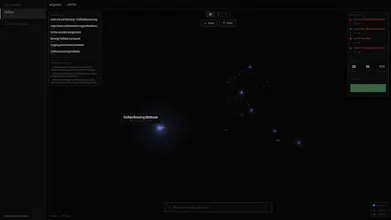
That's what I built. You feed it anything, and it compiles structured knowledge. Features include a knowledge graph representing concepts and relations as nodes and edges, a comprehensive, indexable wiki, and autonomous agents that tend the engram and serve as units of cognition.
Core loop is live and working. Background agents, browser extension, service integrations, and team collaboration are actively shipping. Try it out with a topic you know inside out, whether it be research or coffee.
EAGER TO HEAR THOUGHTS AND FEEDBACK!!!
Report
why can't I just make my own AI Agent for this?
Report
Hunter
@rakesh_jhunjuhnwala you totally can and thats basically how this started. the question is whether you want to spend weeks building and maintaining the compilation pipeline, the indexing, the graph, the UI, the background agents, or just use something that already does it. same reason people use notion instead of building their own wiki in markdown
Report
Interesting concept, but what architecture are you using for memory?
Report
Hunter
@sd393 No vector DB or RAG in the traditional sense. The LLM compiles sources into actual markdown articles incrementally, one source at a time against a lightweight index of what already exists. By query time you're reading structured articles, not retrieving chunks. Happy to go deeper on the compilation loop if you're curious.
Report
how is this different from just dumping papers into chatgpt and asking it to summarize everything
Report
Hunter
@gama_adorama engrams compiles everything into articles that persist, link to each other, and get richer every time you add something or ask a question. its the accumulation that matters not any single response
why can't I just make my own AI Agent for this?
@rakesh_jhunjuhnwala you totally can and thats basically how this started. the question is whether you want to spend weeks building and maintaining the compilation pipeline, the indexing, the graph, the UI, the background agents, or just use something that already does it. same reason people use notion instead of building their own wiki in markdown
Interesting concept, but what architecture are you using for memory?
@sd393 No vector DB or RAG in the traditional sense. The LLM compiles sources into actual markdown articles incrementally, one source at a time against a lightweight index of what already exists. By query time you're reading structured articles, not retrieving chunks. Happy to go deeper on the compilation loop if you're curious.
how is this different from just dumping papers into chatgpt and asking it to summarize everything
@gama_adorama engrams compiles everything into articles that persist, link to each other, and get richer every time you add something or ask a question. its the accumulation that matters not any single response