
EngineEar AI
Weird engine noise? AI tells you what it is.
11 followers
Weird engine noise? AI tells you what it is.
11 followers
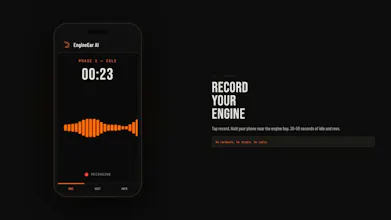
Record ~50 seconds of your engine and EngineEar AI tells you what's likely going on — mechanical causes, urgency, and what to check before the workshop. Wear evaluation: does your engine sound its age? The AI compares its acoustic fingerprint to what a car of your make, year and mileage should sound like. Your garage stays free: multiple vehicles, fuel log, maintenance history, cost stats, backup and restore. Only AI analyses are subscription-based. 21 languages.

does the ai just guess at what might be wrong or does it actually pull from a database of real engine sound samples for my specific model? curious how confident the diagnoses actually are before i pay for a subscription.
@adem132916 Hi Adem,
thank you for your Question. What the AI does here is pattern recognition. Depending on the microphone of the smartphone and environmental noises this can be good or less accurate. We actually configured it that way, that it'll tend to notify more, where might be less, just to cover the possible environmental circumstances , and the input quality loss through a smartphone microphone.
How accurate is the AI actually for weird noises like timing chain rattle versus a worn tensioner? Would love to see what kind of confidence score it gives before I trust it over my mechanic.
@ezel656461 Honest answer on timing chain rattle vs. worn tensioner: these two are one of the harder acoustic pairs to separate cleanly. Both produce metallic rattle in overlapping frequency bands, and the tell — tensioner is often cold-start / low-load, chain wear tends to broaden across RPM — doesn't always show up in a single 50-second recording. The AI usually returns both as ranked mechanical causes rather than committing to one, which I think is the honest output for that specific pair.
On the confidence score — yes, every result includes a Confidence badge (High / Medium / Low) that reflects how cleanly the acoustic signature mapped to known patterns. Low doesn't mean "wrong"; it means "the audio is ambiguous or noisy enough that you should treat the ranking as a hypothesis list, not a verdict." That's why the app is framed as something to walk into the workshop with, not something to replace the workshop.
If you try it, one tip: record in Guided Mode (30 s idle + 20 s revs), and if you can, do one recording cold-start and one warm. The delta between them is genuinely useful for narrowing down chain vs. tensioner — and a good data point to bring to your mechanic either way. Would love to hear whether the ranking matches what they end up finding.