
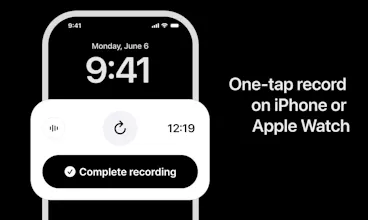
Ellis is an AI notetaker for in-person meetings. Record your meeting, get a clean transcript with each speaker identified, then ask anything — what was decided, what you missed, how it went. No laptop. No extra hardware. Just your iPhone (or Apple Watch).



How well does it handle overlapping speakers or side conversations in a noisy room, and is the transcription actually reliable enough for something like a legal or HR meeting?
@beyzatanrkur6p you can try it for free. I found the combination of speaker diarization and selection works very well.
How does the speaker identification actually work in practice, especially when people are talking over each other in a real meeting?
@zelihay93u thanks with a question. There are multiple steps under the hood.
Users can record a voice profile during onboarding and from settings (voice enrollment).
When a recording finishes, the app uses a diarization process using AssemblyAI, and returns a transcript with multiple speakers.
The app then uses your voice enrollment to find a best match which gets highlighted in the UI
You can then assign yourself as a specific speaker or add names to others if needed.
In-person is the right wedge, every AI notetaker assumes a Zoom link exists. How do you handle speaker attribution in a noisy room without everyone wearing a mic? That's the failure mode that killed my voice-memo system for coffee meetings.
@chielephant oh nice! you built a voice-memo tool yourself?
I'm experimenting with the following setup:
During onboarding users create a voice profile that gets saved to their account (ie. speaker embeddings via Pyannote)
After each recording it uses AssemblyAI's model for diarization and transcript
UI picker to assign yourself and others to the transcript with best match suggestion
Everyone built for Zoom and forgot rooms exist. How does it handle four people around one table with a single phone mic?
@chielephant thanks for the question. A few things:
During onboarding you can create a voice profile that gets saved to your account (ie. speaker embeddings via Pyannote)
After each recording it uses AssemblyAI's model for diarization and transcript
UI picker to assign yourself and others to the transcript with best match suggestion
From my perspective, I don't think the technology is the issue. It's more about privacy and consent since this is designed for IRL conversations, how do you encourage users to make sure everyone is feeling comfortable being recorded ?
@reda_roqai_chaoui at the moment using messaging. There are some other ideas to make it even more explicit, such as a consent toggle. Thoughts?
For me it comes up in fast 3+ person brainstorms and standups, almost never in 1:1s or sales calls where people take turns. I wouldn't chase true source separation, that's a research problem you don't want to own. The cheap win is honesty: when AssemblyAI hands back a low-confidence or overlapping stretch, drop a small 'crosstalk here' marker instead of a clean line, so I know to trust my own memory for that bit. A confidently wrong transcript is worse than one that admits a gap.
@dipankar_sarkar this is great idea. Just to have better understanding for the situation here, can you give me an example of when and how this matters? It is an attribution problem then when you want to give credit, or is it when your own voice get's overlapped? Genuinely curious. Thanks!
how does it handle cross-talk or overlapping speakers when multiple people talk at the same time during the meeting?
@dnde8yg you get a full transcript where you can then easily identify speakers. By cross-talk there are occasional instances where it might identify two speakers as one. But the recent AssemblyAI model is surprisingly good and getting better.