
EasyEnv
Interview Engineers in Real Work Environments
254 followers
Interview Engineers in Real Work Environments
254 followers
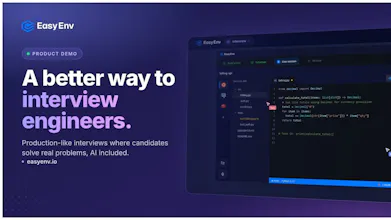
EasyEnv helps companies hire engineers who can actually ship. Candidates solve real-world engineering problems with access to machines, databases, services, logs, and job-like tools. Teams can optionally allow AI chatbots or agents, then evaluate how candidates prompt, verify, debug, and solve problems in practice. Every session is recorded, scored, and easy to review, so hiring decisions are based on real evidence.




Hey Product Hunt 👋
I’m Mo, co-founder of EasyEnv.
In EasyEnv, companies can give candidates real-world problems they might face day to day. Candidates get access to the whole environment, including machines, databases, services, logs, and tools, so they can investigate, debug, and solve problems the way they would on the job.
Companies can also choose to let candidates use AI chatbots or agents during the interview.
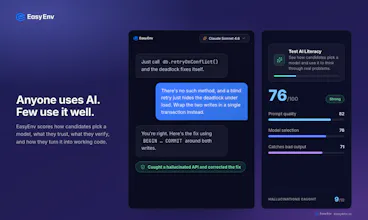
Instead of treating AI as cheating, teams can see how candidates actually use it: how they think, prompt, verify, debug, and move faster without losing judgment.
Our goal is simple: help companies hire engineers who can actually ship in the AI era.
We built EasyEnv because engineering interviews should reflect how people actually work today.
I’d love your feedback: how should companies evaluate AI skills during technical interviews?
@efazati
Having a history of AI usage during interview seems a good idea, maybe tracking their token usage would be interesting as companies started to see the efficiency of using AI!
Overall, Seems very nice product, I like it till here!
Seem like a nice product. One question, when a candidate uses AI during the interview, how do you separate "strong engineering judgment" from "fluent with this specific AI tool"? A candidate who lives in Claude Code or Cursor every day will move very differently from someone equally skilled who just hasn't built the muscle memory, even if their underlying judgment is identical. How does EasyEnv score the thinking (how they prompt, verify, and catch the AI being wrong) without accidentally rewarding tool familiarity or penalizing it?
@arash_mousavi That’s a great question, and honestly one of the reasons we built EasyEnv this way.
We don’t want to score candidates just on how fast they move with a specific AI tool. Tool familiarity can definitely create noise. What we care about is the engineering process around AI: how they break down the problem, what they ask AI, how they verify the output, how they react when AI gives a wrong or incomplete answer, and if they can still reason through the system themselves.
So the AI usage is not scored in isolation. It is evaluated together with the full session: terminal activity, code changes, logs, debugging steps, final result, and the decisions they made along the way.
A candidate who is very fast with Cursor or Claude Code may look smoother, but if they copy blindly or fail to validate, that should show up. On the other hand, someone less familiar with the tool can still score well if they show strong debugging, good judgment, and careful verification.
Our goal is not to reward “AI power users” by default. It is to help teams see how candidates use AI as part of real engineering work.
This is awesome, it's solving a real problem for us. We've had exactly this challenge and tried adapting Coderpad and other coding interview tools, but none of them felt built for it. We also tried a more handmade setup with Codespaces, but it took a lot of boilerplate config and ended up clunky.
@fabricio_lemos Thank you, really appreciate that 🙏
That’s exactly the problem we kept seeing too. Existing coding interview tools are useful, but they are usually not built for real-world engineering workflows. And handmade setups with Codespaces or custom environments can work, but they take a lot of time to prepare, configure, and maintain.
That’s why we built EasyEnv: to make these realistic interview environments easier to create, run, review, and reuse.
The part that gets me is being able to actually watch how someone works instead of just grading the end result. Has a session ever flipped your read on a candidate? Like someone who looked great on paper but kind of fell apart once things got messy, or the opposite - someone you weren't sure about who turned into a total debugging machine the second they had real logs in front of them. Curious if you've seen that yet.
@pavlo_kovalchuk1 Yes, we’ve seen this many times.
Some candidates look very strong on paper and can answer theory questions well, but once they get into a real environment with logs, services, errors, and incomplete information, they struggle to decide what to check next.
And we’ve also seen the opposite: candidates who don’t look perfect on a resume, but once they have real logs and a system in front of them, they become very strong. They stay calm, investigate step by step, form good hypotheses, and keep narrowing the problem down.
That’s the signal we care about. Not just the final answer, but how they move through uncertainty.
This is a really strong direction for technical hiring. As someone who works more on infrastructure/SRE/cloud than pure algorithms, I’ve always felt realistic debugging and system investigation tasks give a much better signal than LeetCode style questions.
Curious how EasyEnv handles scoring. does it mainly evaluate the final solution, or also the candidate’s investigation path, tool usage, and decision making during the session?
@mehdi_bayazee Thanks, really appreciate that 🙏
We think the same, especially for infrastructure, SRE, DevOps, and cloud roles. The final result matters, but it is only one part of the signal.
EasyEnv also helps teams review the candidate’s investigation path: what they checked first, how they used logs and tools, how they formed hypotheses, what changes they made, and how they verified the result.
So the goal is not just to ask “did they fix it?” but also “how did they think, debug, and make decisions along the way?”
Huh! Hopefully interviewing will be less stressful if more companies adopt this solution, instead of having to go refresh l33t coding skills every couple of years :P
@nickrossolatos Haha exactly 😄 That is a big part of the idea.
Most engineers don’t spend their day solving LeetCode problems. They read logs, debug systems, understand services, use tools, ask good questions, and figure things out.
We want interviews to feel closer to the real job, and hopefully less stressful for candidates too.
Hi Product Hunt!
I'm one of the co-founders of EasyEnv.
Building EasyEnv has been an interesting journey because we kept asking ourselves one question: Why don't technical interviews look more like the actual job?
Instead of whiteboard exercises or isolated coding challenges, we wanted candidates to work in real environments, investigate real issues, collaborate with AI when appropriate, and demonstrate how they think under realistic conditions.
Seeing the first teams use EasyEnv has been incredibly rewarding, and we're just getting started.
Thanks for checking us out, and we'd love to hear your feedback. What would make technical interviews feel more representative of real engineering work?