DriftLens (InsightOS™) is a reflective journaling system for decision-making. Enter your Purpose and Reflection, and it combines AI, neuroscience, and Buddhist cognitive frameworks with real monastic guidance—offering depth AI alone can’t authentically reproduce. It turns tangled thoughts and emotions into structured clarity: map your loops, reduce cognitive load, and see what’s triggering your reactions in real time. Reflection as training, not belief.
No reviews yetBe the first to leave a review for DriftLens
Maker
📌
An introspective journaling system, “DriftLens,” grounded in real monastic guidance.
Many high-performing professionals—and the workplaces they operate in—are increasingly facing burnout and mental strain. We’ve hosted live classes led by monks, and we kept seeing the same pattern: people often turn inward only after they’ve already burned out. And even when they genuinely want deeper teachings, they struggle to translate them into real, day-to-day decisions.
Most people try to “solve” mental tension through thinking alone—without access to felt sense (body signals, tension, impulse, reactivity) and without a method to train that perception.
DriftLens blends AI, neuroscience, Buddhist cognitive frameworks, and real monastic guidance to turn raw emotion and thought into structured clarity. Instead of free-form journaling, it helps you map loops, reduce cognitive load, and see what’s triggering your reactions in real time—reflection as training, not belief.
Powered by InsightOS™, DriftLens helps you structure what’s hard to name—transforming scattered thoughts and half-formed feelings into clear language, recognizable patterns, and decision-ready clarity.
As founders, we need to relearn a basic truth: success doesn’t have to mean letting go of wellbeing.
Founder RIe
Report
Maker
DriftLens — how it works
Modern work isn’t just “busy.” It’s constant context switching + unclosed mental loops.
DriftLens is an introspective journaling system that converts your raw internal noise into structured clarity using a simple protocol:
1) Purpose = direction What are you trying to see clearly right now?
Then InsightOS™ organizes your entry through multiple lenses (loop detection, clear observation, pattern shift over time, synthesis), so you don’t just “vent”—you get a map.
Why introspection reduces cognitive overload
Cognitive overload often comes from unprocessed internal load: open loops, rumination, threat-monitoring, and constant reprioritization running in the background.
Structured introspection helps because it:
Externalizes the load (turns vague pressure into explicit data)
Separates signal from story (less emotional fusion, less reactive escalation)
Closes loops by naming what’s recurring and what’s reinforcing it
Restores choice under pressure (you can respond, not just react)
It doesn’t “fix you.” It helps you see the system—so you can stop burning bandwidth on invisible background processes.
Report
Maker
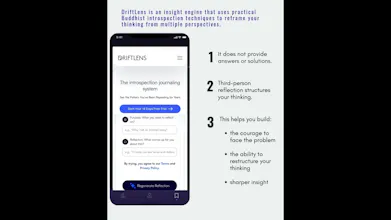
DriftLens isn’t an AI that gives you answers or “fixes” your life. It’s introspection training.
You write two things—Purpose and Reflection—and DriftLens helps you map what’s happening inside you: the signals, loops, and patterns shaping your thinking and behavior. Not to judge you. Not to score you. But to make the structure visible so you can see it from multiple angles—without getting pulled in.
The point isn’t an AI-generated solution. The point is rebuilding your ability to observe, think, and choose—especially under pressure.




DriftLens — how it works
Modern work isn’t just “busy.” It’s constant context switching + unclosed mental loops.
DriftLens is an introspective journaling system that converts your raw internal noise into structured clarity using a simple protocol:
1) Purpose = direction
What are you trying to see clearly right now?
2) Reflection = evidence
What’s actually happening—signals, friction, thoughts, reactions?
Then InsightOS™ organizes your entry through multiple lenses (loop detection, clear observation, pattern shift over time, synthesis), so you don’t just “vent”—you get a map.
Why introspection reduces cognitive overload
Cognitive overload often comes from unprocessed internal load: open loops, rumination, threat-monitoring, and constant reprioritization running in the background.
Structured introspection helps because it:
Externalizes the load (turns vague pressure into explicit data)
Separates signal from story (less emotional fusion, less reactive escalation)
Closes loops by naming what’s recurring and what’s reinforcing it
Restores choice under pressure (you can respond, not just react)
It doesn’t “fix you.” It helps you see the system—so you can stop burning bandwidth on invisible background processes.
DriftLens isn’t an AI that gives you answers or “fixes” your life.
It’s introspection training.
You write two things—Purpose and Reflection—and DriftLens helps you map what’s happening inside you: the signals, loops, and patterns shaping your thinking and behavior. Not to judge you. Not to score you. But to make the structure visible so you can see it from multiple angles—without getting pulled in.
The point isn’t an AI-generated solution.
The point is rebuilding your ability to observe, think, and choose—especially under pressure.