Discontinuous Analysis

Discontinuous Analysis

Analysis of any functions, not only continuous ones

9 followers

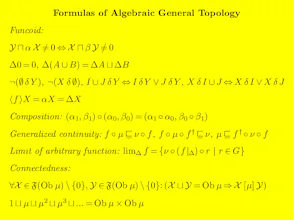
Discontinuous Analysis is a novel way of calculus of any functions, not only differentiable or continuous. It is based on "generalized limit" that is defined for every function at all points. This helps to skip existence check during calculations + QG research
Discontinuous Analysis gallery image
Free
Launch tags:AmazonEducationScience
Launch Team
Anima Playground
AI with an Eye for Design
Promoted

What do you think? …

Victor Porton
Maker
📌
Hey, check my Discontinuous Analysis book. Its applications range from simplifying usual engineering calculations to new concepts in General Relativity and Quantum Gravity. I do this by defining "generalized limit" defined for all functions (provided suitable topological structure in the domain and image) at every point. "No limit for all functions at every point? No square root of -1? There is (in a wider space)." Generalized limit allows to easily define derivative for all functions at every point, integral of every function, and sum of any series (no, in my notation, 1+2+3+... != -1/12, it is a proper infinity). This theory greatly helps to simplify usual engineering calculations, because you don't need, for example, to check that a derivative exist and can cancel f'(x) - f'(x) = 0 without first checking for existence. Second, I make certain General Relativity (with my space of generalized limits instead of real number values) and quantum gravity conjectures. Solve them and share a Nobel Prize with me. Probably, we have another explanation of quantum information paradox than Hawking radiation. Does Hawking radiation even exist?
Victor Porton
Also note that my theory is more "powerful" than the traditional (I'd say "legacy") way to deal with infinities, namely Distributions Theory: In distributions theory you can't even multiply two functions without first calculating a complex integral to check that they are "compatible". In my theory, on the other hand, you can do any algebraic operations (defined for your base "numbers" or "vectors") on generalized limits. Just use my book to simplify your everyday engineering calculations.
Alexander William Hawkins
Sounds like a very intriguing book. Haven’t had the chance to dive deep into it yet, but the concepts look groundbreaking. Congrats on the release!