
discode.ai
100+ AI models, one interface. ECO friendly.
656 followers
100+ AI models, one interface. ECO friendly.
656 followers
discode is your EU-friendly AI router: one interface for 100+ models, with every prompt auto-routed to the best one for the job. Or fine-tune it yourself along Smarter, Speed and Eco. It shows you which model answered and why, redacts your personal data on-device before anything leaves, checks the hard answers across multiple models, and estimates the CO₂, water and energy footprint of every request. Built in Vienna 🇦🇹. Your AI, your rhythm.




Congrats on the launch! 🚀
The eco angle is refreshing, but I also really like the on-device privacy filtering. Most AI routers focus only on cost and speed, while privacy and model choice are just as important.
Curious how transparent the routing explanation is for non-technical users can they easily understand why a specific model was selected?
@prashant_patil14 Thanks for the kind words. Transparency is exactly the part we obsess over.
The design goal: the best router is one you can ignore completely, but the moment you look, nothing's hidden — and you never need a technical background.
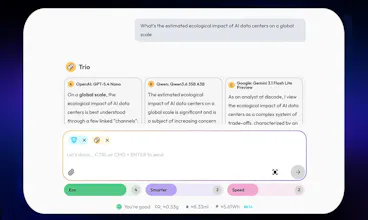
Instead of picking from 100+ models in a dropdown, you steer with three controls — Quality, Speed and Eco — like an equalizer. You set the vibe, the system picks the lane: simple questions go to fast, low-footprint models, harder ones move up to stronger ones automatically. Every answer shows the model that handled it right beneath it. And if you'd rather drive, a manual override is one tap away.
Where it gets really visible is Trio mode: you watch multiple models work the same question side by side, in real time — no hidden orchestration. We're also planning out a plain-language "why this model" explanation on every answer, so the reasoning is one tap away, not a black box.
Let me know if you have any further questions
The eco footprint per request is a great touch. What data source are you using for the CO2 estimates per model? Numbers vary a lot by datacenter location and grid mix, curious how granular you can get.
@christian_knaut
Christian, you're touching on exactly the hard part. The CO2 footprint of a model call is a product of several compounding factors:
Hardware type and efficiency - different chip generations have noticeably different energy profiles per token
Batch utilization - a GPU running well below capacity burns power roughly comparable to one running near full load, so how many requests share the same hardware matters a lot
Datacenter location and grid mix - this is the biggest lever.
A model running on a low-carbon grid sits at a fraction of the footprint of the same model on a coal-heavy grid; the gap between them can be substantial for identical compute
PUE (Power Usage Effectiveness) - the overhead of cooling, lighting, and facility power on top of IT energy, which varies significantly by datacenter design
Water use - often overlooked, but cooling systems consume a meaningful amount, and we track this as well
Model architecture - for MoE models, only a portion of parameters are active per token, so using total parameter count would meaningfully overstate the energy cost
Decode vs prefill split - generating output tokens costs noticeably more energy per token than processing input, so a short prompt with a long answer looks quite different from the reverse
For all of these we rely on publicly available data - mainly grid intensity figures and published datacenter environmental reports - and we've formed a working group with ESG-Cockpit to sharpen the methodology.
The honest limitation: closed-source model architectures have to be estimated, and Scope 3 emissions (hardware manufacturing and supply chain) are excluded, which is industry standard but still an undercount. We flag that in the product.
It's an evolving picture and we're actively working to close the gaps.
Let me know if you have any further questions
Congrats on the launch! Which sources do you actually use to calculate CO2, water and energy?
@francisrafal Thanks, Francis, lovely question to get.
We don't invent these numbers. There's very little public research on AI's footprint, and over the last months we've read pretty much all of it and built our estimate on top. That's also the catch: as a router we can't know the exact data centre your request hits, how loaded that machine is, or what's inside the closed models, so any single number is easily plus or minus 50 percent.
So we're upfront that it's an estimate, not a measurement: a compass, not a measuring device. Where it's reliable is the relative call, which model or provider is lighter for a given task, the bike-or-van decision. That's the part that helps you choose.
Happy to go deeper if it's useful. 🪩
Mo
the auto-routing is the real differentiator here — most multi-model platforms still make you pick manually, which defeats the purpose if you don't already know which model handles what best. curious how the routing logic works under the hood, especially for edge cases where two models are equally good but one costs 10x less. the CO2 tracking is a nice touch too, haven't seen that baked into a router before.
@ozandag Thanks, Ozan, you've named the exact case the router lives for. Every prompt is sized up front (task, complexity, language) and scored against your priorities, which you set with three sliders: Smarter, Speed, Eco. So it isn't "pick the strongest model," it's "best fit for this task and these settings." Your 10x case is the easy one for us: on a quality tie, the cheaper and lighter model wins by default, there's no reason to pay or burn more for the same answer. Lean the sliders toward Smarter and the bar for a "tie" rises; lean Eco and the frugal one wins even more often. The footprint sits right inside that call, since a tie on quality is rarely a tie on CO2.
Hey everyone, Moriz here, the one who started this whole disco. 🪩
Quick confession: I can't code. My last brush with it was an HTML course in the late 90s, and I'm part of a coffee-house project in Vienna. So, very much not a techie. A few months ago I got stuck on questions nobody seemed to be building for:
What does AI cost the planet, and how do you let people see it, steer it, and weigh the trade-offs without guilt?
AI is confidently wrong. What does honest uncertainty look like when reliability matters?
When a doctor or lawyer uses AI, their patients and clients are exposed, usually without anyone noticing. Why isn't privacy the default for ordinary people, not just an enterprise feature?
So I went down the vibecoding rabbit hole. The irony isn't lost on me: using Claude Code to build something meant to be more responsible than Claude itself. Three Claude Max subscriptions and $2,000 in API tokens later, my first version was a glorious 417,000-line monster. After countless night shifts and weekends next to the day job, I understood I'd need real pros to ship this. A small crew of engineers and designers then carved that monster into something beautiful that actually works. Thousands of hours and a lot of love and creativity went into it. Thank you, all of you. (We're hoping to earn that carbon back, too.)
Pete already gave you the what: the routing, Eco, Challenger, the on-device privacy filter. So let me give you the why.
The race everyone's running is about who has the biggest model, who has the biggest... data centers, who has the biggest IPO. We want to open a different one. Not how AI gets more powerful or how you get rich off it, but how we build the best interface between people and these machines, so they serve us, and so Europe is more than the raw material quietly feeding them our data. Pro-European, not anti-American. I don't think we should only consume what others build.
We're nowhere near done. The Eco score is a first step, which is why it's in beta. discode is a lab and a playground for human-centered AI, and it gets better with you in it. So please: tell us what's broken, what's missing, what you'd do differently. And if we ship your idea, there are discode credits in it for you. Every honest note steers where this goes. 🙏
You choose the rhythm, not the algorithm.
Mo
@mo_riz it's been a great pleasure working on this mission with you and the team.
Let's go!
@peterbuch thank you peter for the ride and learning opportunity🙏
That's the trap we hit when we tried wiring re-asks back into routing. Raw re-ask rate was a noisy label, roughly half of ours were the user refining their own question, not the tier failing them. We had to gate on intent: only count a re-ask as an escalation signal when the follow-up keeps the same semantic intent as the original, otherwise a chatty user reads as a broken router. Worth deciding that filter before re-asks ever touch the tier boundaries.
The Eco readout is the part I haven't seen anyone else actually ship, and it's overdue. What I keep wondering is where the CO2 and water numbers really come from. Providers don't publish per-request energy or which hardware served you, so is this basically tokens times a per-model coefficient, or something more grounded? Reason I ask: if the estimate is off by 2-3x, the eco-slider could quietly nudge people the wrong way. Either way, putting that bill in front of people is the right instinct.