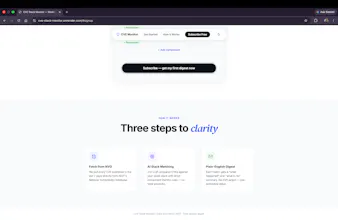
Most security tools blast you with hundreds of CVEs a week. 99% don't affect what you run. CVE Stack Monitor flips that: enter your stack once, and every Monday it scans NIST's National Vulnerability Database, uses an LLM to filter only CVEs that directly match your components, and emails a plain-English digest — CVSS score, what happened, what to patch. This week: CVSS 9.1 Critical in the Linux kernel, caught before Monday morning standup.
No reviews yetBe the first to leave a review for CVE Stack Monitor
Maker
📌
Hey PH 👋 — maker here.
I built this because I kept doing the same manual thing: open NVD, search for each component in our stack, filter by date, try to figure out if it actually applied to us. Every. Single. Week.
The existing tools are either enterprise (Snyk, Dependabot) and require code access, or they're newsletters that blast you with everything. There was no middle ground for "just tell me what's relevant to my infra stack."
So I built it. Here's literally how it works:
You enter your stack (Node.js, PostgreSQL, nginx, Linux kernel, whatever)
Every Monday it hits the NVD API and pulls the last 7 days of CVEs
Llama 3.3 (via Groq) filters them against your exact components with strict identity rules — no false positives
You get an email like the one in the screenshots: CVSS score, plain-English summary, direct NVD link
This week's real output for a Linux kernel subscriber: CVSS 9.1 Critical (CVE-2026-46244, netfilter nft_inner IPv6 desync) + 6 HIGH severity issues. That's the signal — not 400 CVEs.
It's completely free right now. 1 stack, weekly digest, unlimited components. I'm building toward Pro (multiple stacks, Slack/Teams alerts, daily scan option) but wanted real feedback first on what actually matters to people.
Two things I'd love your input on:
What stacks are you running that you'd want monitored?
Is weekly the right cadence, or would you pay for daily?
Drop a comment and I'll reply to every one. → https://cve-stack-monitor.onrend...