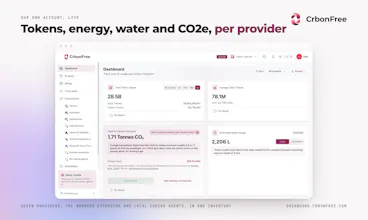
We run CrbonFree on our own accounts. Over the past year our team used 33.4 billion tokens, which came to 2.64 tonnes of CO2e and 858 kWh of electricity. The dashboard compares that to driving a typical sedan for a year. Almost all of it was input: 33.3 billion tokens read against 94 million written.
We're curious where other teams land. If you've tried to put a number on your AI use, what did you get, and what made it hard? And what would you need to see before trusting a figure like this in a sustainability report?
Every factor we use is on our methodology page, so push back on anything that looks off.





CrbonFree
Hi everyone, Sadi from Crbon Labs.
We built CrbonFree because AI had become a real line in company budgets, but it was missing from their carbon inventories. Every tool we found estimated it, usually from a calculator or an average per query. An auditor can't sign off on a guess, and from September 2026 the EU bans the carbon-neutral claims that used to paper over the gap.
CrbonFree connects to the providers you already pay (OpenAI, Anthropic, OpenRouter, Bedrock, Vertex and the Vercel AI Gateway) and reads the usage they meter, token by token. Each call gets an energy, water and CO2e figure. We publish the whole methodology, down to every factor and formula, and each figure comes with an uncertainty band. You end up with a report that someone outside your company can check.
Measurement is the centre of the product. Climate action is separate and optional: if a customer retires credits, that money never changes the measured footprint. We also put the numbers where engineers already work, so there's a CLI, TypeScript and Python SDKs, an MCP server, and a browser extension for the ChatGPT and Claude use that never touches an API key.
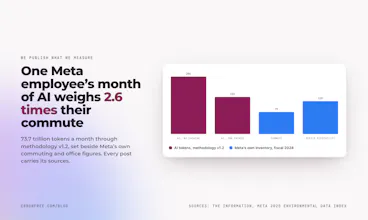
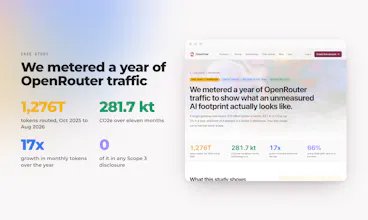
Our first beta customer is a billion-token-a-month user, and the SDKs and MCP server have passed 4,500 downloads with zero paid marketing. We write up what we measure on the blog, most recently what Meta's 73.7 trillion tokens a month weigh per employee.
Ask us anything about the methodology. It's the part we're proudest of, so try to break it.