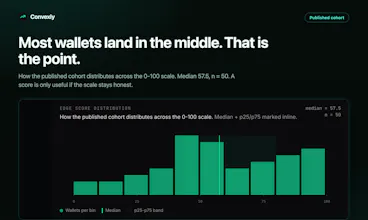
Every prediction market ranks traders by profit, but over a few dozen bets, profit is mostly luck. Convexly is an independent skill-vs-luck audit for Polymarket wallets. Paste any wallet address and in about 30 seconds get its realized edge with a 95% confidence interval, calibration by market category (Brier score), and an Edge Score against a frozen 8,656-wallet reference cohort. Free, no signup. Frozen methods, public data, and negative results that stay published.
No reviews yetBe the first to leave a review for Convexly
Maker
📌
I built this because every Polymarket leaderboard ranks wallets by profit, and profit is mostly survivorship. One lucky whale bet looks identical to skill until you put an interval around it.
The analyzer reads a wallet's resolved record only. Realized edge with a bootstrapped 95% interval, clustered by event so 50 positions on one election night don't count as 50 independent bets. Below 30 resolved positions it refuses to call anyone skilled, which annoys people, and that's kind of the point. We ran our own published top-50 leaderboard through the same bar and most wallets didn't clear it. That result is on the site and it stays there.
Free, no signup. Paste a wallet, argue with the verdict. If the method is wrong somewhere I want to know, the methodology pages are public.
Report
How does the Edge Score actually get calculated against the 8,656-wallet cohort, and are you weighting newer wallets the same as ones with years of historical data?
Report
Maker
@cemilalpermgp8 Fair question. Short version on the second half: not by age, by sample size.
The score is a percentile against a frozen 8,656-wallet cohort. Under the hood it's three z-scored pieces: how calibrated the wallet is (baseline Brier minus its own), how concentrated its PnL is (that one carries the most weight), and how many resolved positions it has. Rank that against the cohort and you get a 0 to 100. In-sample Spearman is +0.42, and I keep saying in-sample because that's what it is. I haven't shown it holds out of sample yet and I'm not going to pretend otherwise. Full coefficients are on the methodology page.
On age: no, we don't fade old bets or favor recent ones. It reads the whole resolved record. What actually protects against a thin or brand-new wallet is the interval, not a date filter. The 95% band is a clustered bootstrap, so it blows out when there aren't many resolved positions, and under 30 the tool just won't call anyone skilled. Ten years and 12 resolved bets gets the same shrug as a week-old wallet with 12.
If you think recency should count for more, make the case and I'll listen. Or paste a wallet you think it's getting wrong and I'll look.
Report
Maker
@cemilalpermgp8 Correction to my own comment above: the composite's in-sample Spearman is +0.514, not +0.42. I conflated it with the calibration-only correlation from our whale audit. The methodology page has the exact number. That's on me.
How does the Edge Score actually get calculated against the 8,656-wallet cohort, and are you weighting newer wallets the same as ones with years of historical data?
@cemilalpermgp8 Fair question. Short version on the second half: not by age, by sample size.
The score is a percentile against a frozen 8,656-wallet cohort. Under the hood it's three z-scored pieces: how calibrated the wallet is (baseline Brier minus its own), how concentrated its PnL is (that one carries the most weight), and how many resolved positions it has. Rank that against the cohort and you get a 0 to 100. In-sample Spearman is +0.42, and I keep saying in-sample because that's what it is. I haven't shown it holds out of sample yet and I'm not going to pretend otherwise. Full coefficients are on the methodology page.
On age: no, we don't fade old bets or favor recent ones. It reads the whole resolved record. What actually protects against a thin or brand-new wallet is the interval, not a date filter. The 95% band is a clustered bootstrap, so it blows out when there aren't many resolved positions, and under 30 the tool just won't call anyone skilled. Ten years and 12 resolved bets gets the same shrug as a week-old wallet with 12.
If you think recency should count for more, make the case and I'll listen. Or paste a wallet you think it's getting wrong and I'll look.
@cemilalpermgp8 Correction to my own comment above: the composite's in-sample Spearman is +0.514, not +0.42. I conflated it with the calibration-only correlation from our whale audit. The methodology page has the exact number. That's on me.