
Context.dev gives your AI agents and apps real-time access to structured web data, no brittle scraping infrastructure needed. Scrape any URL as clean markdown or HTML, extract brand data (logos, colors, fonts, socials) from any domain, crawl sitemaps, resolve transaction descriptors, and more. Typed SDKs for TypeScript, Python, and Ruby. Trusted by 5,000+ businesses including Mintlify, Daily.dev, Ferndesk.com, and more. Most teams integrate in under 10 minutes.
This is the 2nd launch from Context.dev. View more
Context.dev
Launched this week
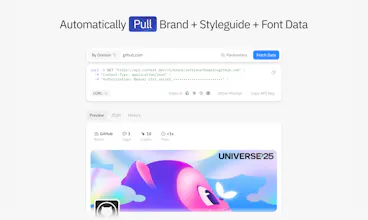
Context.dev is the web context API for AI products and agents. Scrape any URL, crawl sites, turn pages into LLM-ready Markdown, extract structured data into your own schema, capture screenshots, and retrieve logos, colors, fonts, styleguides, company data, and transaction enrichment through one API. YC-backed, no card required, and built so developers or coding agents can integrate in minutes.



Free Options
Launch Team / Built With


Clean markdown per URL is the right primitive, but the thing that bites agents downstream is structural stability run to run. If the same URL returns a slightly different markdown shape each fetch (nav reordered, a section collapsed), an agent parsing it breaks even though the scrape technically worked. Do you normalize to a stable structure, and how do you handle sites that serve bots different HTML than a real browser? We've had agents silently derail because the page they got back wasn't the page a human sees.
Context.dev
@dipankar_sarkar markdown is never what a human sees!
We have a near perfect browser rendering stack. You can try it yourself :)
Context.dev
@shubham4real agreed!
The agent-native onboarding is the part that stopped me, most APIs assume a human reads docs and wires a key in manually. Letting a coding agent paste one line, sign itself up, and grab a key end to end is a genuinely different distribution bet.
That's also my real question: what stops that flow from becoming a free-tier abuse vector? If an agent can self-provision with no human in the loop, nothing stops another agent from looping ten signups to dodge rate limits. Is there verification or a review gate before a self-signed-up key actually starts working?
Congrats on the launch!
Context.dev
@keirodev we have really advanced fraud protection. We get attacks nearly daily for the past year and have developed our own way of stopping it immediately and preventing it all-together
Really good question.
@yahia_bakour3 Good to know the system is battle-tested, a year of near-daily attacks is real signal ! Still curious whether it holds the same way for the agent-native path specifically, a human signup gives you a browser session, a device fingerprint, maybe a captcha to key off of, an agent hitting the API directly hands you far fewer signals to work with. Is that flow covered by the same system, or does it get extra friction (email verification, per-IP rate limiting) because it's a thinner surface to catch fraud on?
Context.dev
@keirodev yep, caught there too!
I'm so glad I discovered Context.dev. My first task was collecting SVG logos for hundreds of brands. I tried many tools, paid and open source, and only Context.dev solved it.
Getting started with the API was easy. I especially liked the ready-made prompt for Claude Code. It took just a few minutes from registration to seeing results in my project.
Now I use Context.dev in my personal projects and recommend it to my clients when I do AI transformations of their websites. The use cases keep multiplying for me. Custom reports, logos, branded Open Graph images.
@yahia_bakour3 thank you for this service! Happy to support it 🙌
Context.dev
@zmoki SUPERB to hear, thank you!!
The tricky part on that hash is that 'material' is consumer-specific: a price flip matters to a catalog agent, a nav reshuffle doesn't, but an agent watching layout wants the reverse. If you can surface the structured diff and let the caller pick which spans count, with your materiality hash as the sensible default, you sidestep everyone fighting one baked-in definition of meaningful. Glad it's already on the roadmap.
Context.dev
@dipankar_sarkar 100%, it's a really hard problem to solve developer-experience wise, we iterate more on the interface than the actual tech just because we want it to be intuitive for everyone.
What's your background btw? these are very solid questions.
Been using this to replace a scraper that kept breaking. One API call, clean markdown back. The brand data extraction (logos, colors, fonts) is surprisingly useful for onboarding flows. Handles JS-heavy sites better than I expected. 5000+ customers is a decent trust signal. Some niche sites still struggle, but overall solid.
Context.dev
@rick_borduur amazing! Thank you so much.
The agent-native angle is interesting. The part I would want very visible in the docs is the failure contract: what comes back when a page blocks rendering, the sitemap is stale, extraction is partial, or a screenshot and markdown disagree?
For agents, a clean markdown string can look more complete than it really is. I would rather get a boring status like blocked / partial / stale-source, plus the URL and capture metadata, than have the caller guess whether the context is trustworthy.