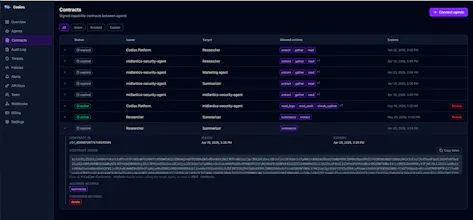
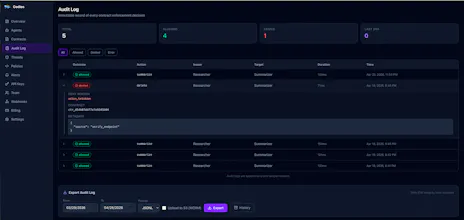
AI agents trust each other because they're on the same network. That's not trust — it's hope. Codios gives every agent a cryptographic identity (Ed25519 + DID:key) and issues signed contracts between them. Agent A can only call Agent B within the scopes the contract specifies. Verified locally — zero added latency, no call home on the hot path. Free tier: up to 5 agents. SDKs for Python and TypeScript. CLI for teams that prefer the terminal.
Hey Product Hunt 👋
I built Codios after running into the same problem repeatedly: multi-agent AI systems where every agent trusts every other agent simply because they share a network. A payment agent that accepts calls from anything on port 8080 isn't secure — it's just unaware.
The core idea: every agent gets an Ed25519 keypair and a DID:key identifier. When Agent A wants to call Agent B, it presents a signed contract specifying exactly what it's allowed to do — scopes like "payment:charge:max_10000usd". Agent B verifies locally in ~10µs. No network call. No single point of failure. Already-issued contracts work even if Codios is unreachable. The name is a deliberate reference to Ripple's Codius project (2014), which was building the same trust model for smart contract hosts. AI agents are now the workload Codius was designed for.
What it ships with today:
→ Agent registry with Ed25519 keypair generation
→ Signed capability contracts with scope enforcement
→ Nonce-based replay protection
→ Immutable audit log for every enforcement decision
→ Python + TypeScript SDKs and a CLI
→ FastAPI and Express middleware (one decorator)
→ Free tier for up to 5 agents
You can check straight demo here: https://codios.midlantics.com/demo
Happy to answer anything — especially questions about the cryptographic design, how it compares to mTLS or OAuth, or where we're taking it next (cross-org delegation chains and agent economic coordination are on the roadmap).
Report
Reviews
No reviews yetBe the first to leave a review for Codios - AI Agent Caging Infrastructure